
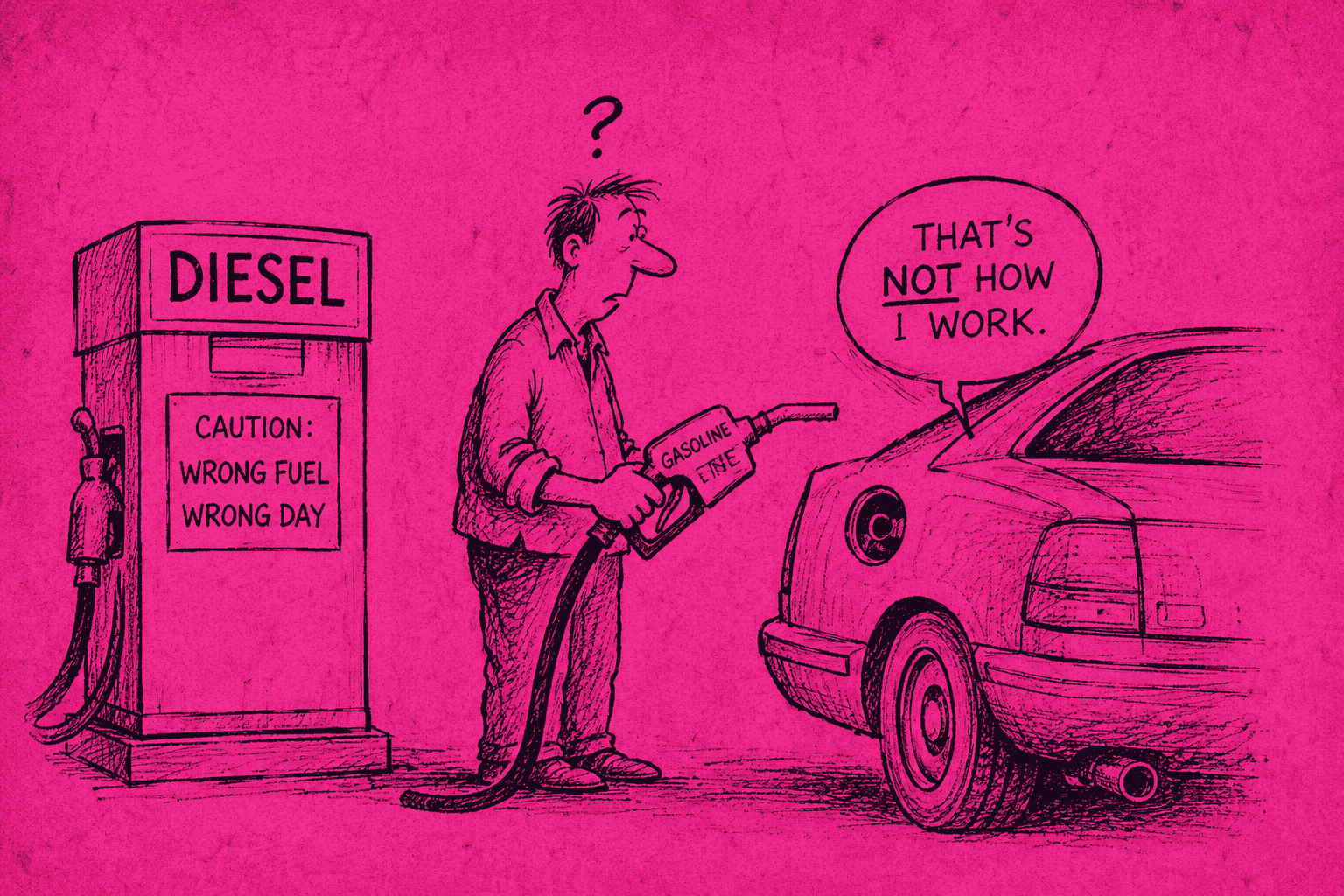
What Happens When You Put the Wrong Fuel In Your Engine
A scientifically-grounded breakdown of three common fuel mixing mistakes — and why each one is expensive, predictable, and completely avoidable.
Every year, thousands of drivers make a critical mistake at the pump. They grab the wrong nozzle, and within seconds, they’ve contaminated their engine with incompatible fuel. The consequences range from a rough idle to complete mechanical failure. What follows is the science behind three specific mistakes — what physically happens, why it happens, and why the damage is almost always irreversible.
Petrol in a Diesel Engine
The most common mistake. The most expensive consequence.
A driver pulls in to refuel, distracted or unfamiliar with a rental diesel vehicle. They fill up with petrol. The tank now contains a mix of light, volatile gasoline molecules (C₅–C₁₀ carbon chains) sitting among heavy diesel molecules (C₁₂–C₂₀). These two fuels are fundamentally incompatible — not just in performance but in the physical laws they’re built around.
The engine might start. It might idle for a few seconds. What follows next is mechanical destruction in slow motion.
Compression Ignition Mismatch
Diesel engines have no spark plugs. They compress air to roughly 500 psi, raising the temperature to around 500°C. Diesel (cetane rating ~45–55) is formulated to auto-ignite reliably at these conditions. Petrol (octane rating ~87–98) is deliberately engineered to resist auto-ignition — it’s designed to wait for a spark. In a diesel engine, petrol vaporises too rapidly and ignites either too early or in an uncontrolled surge, creating detonation: a violent, uncontrolled explosion that hammers the piston downward with 2–3× the normal force.
Fuel System Destruction
Diesel’s higher viscosity (2.0–4.5 mm²/s vs petrol’s 0.4–0.8 mm²/s) is not a trivial difference — it’s the basis for how high-pressure diesel pumps and injectors lubricate themselves. Petrol is thin and dry by comparison. When it flows through diesel injection components, it removes the lubricating film between metal surfaces. Pump internals score and seize. Injectors cavitate and erode. These precision components operate at pressures above 2,000 bar in modern common-rail systems. At those pressures, inadequate lubrication causes metal-to-metal failure in minutes.
Piston, Rod, and Bearing Damage
Detonation creates shock loading across the entire reciprocating assembly. Connecting rods bend. Piston crowns crack or melt. Cylinder walls score. Bearings — which depend on a thin hydrodynamic oil film to separate metal from metal — lose that film under the shock load and begin to wear metal-on-metal. Once this begins, it accelerates non-linearly. The engine seizes.
Exhaust and Aftertreatment Failure
Petrol burns hotter and faster than diesel. The exhaust system in a diesel engine — including the turbocharger turbine, the diesel oxidation catalyst, and the diesel particulate filter (DPF) — is not rated for petrol combustion temperatures or chemistry. The DPF melts or shatters. The turbo overspeeds. Exhaust manifolds crack. In some cases, the engine catches fire.
Damage Assessment
Diesel in a Petrol Engine
The reverse mistake. Often recoverable — if you catch it in time.
The scenario flips: a petrol car gets filled with diesel. The fuel tank now contains diesel — long-chain hydrocarbons (C₁₂–C₂₀) designed to ignite under compression, not spark. The petrol engine turns over, but combustion either fails completely or sputters for a short distance before stalling.
This mistake is less catastrophic than its inverse, but only if you don’t drive. Every kilometre of movement multiplies the damage.
Spark Plug Failure to Ignite
Petrol engines rely on spark plugs delivering 20,000–40,000 volts to ignite a precisely atomised fuel-air mixture. Diesel’s auto-ignition temperature is ~250°C (reached under compression), but its spark ignition threshold is substantially higher than petrol’s. The spark occurs — but the diesel molecules, with their longer carbon chains and different activation energy requirements, don’t break apart and combust reliably from a spark. The result is misfires, rough running, and a near-immediate stall.
Injector and Fuel System Clogging
Petrol injectors are calibrated for fuel with viscosity around 0.4–0.8 mm²/s. Diesel is 5–10× thicker. It clogs injector nozzles (openings of ~0.5mm), disrupts fuel spray patterns, and overpressurises the fuel rail. The fuel pump strains against the increased resistance. Even if the engine starts briefly, the fuel delivery system is compromised within minutes.
Crankcase Contamination
Unburned diesel accumulates in the combustion chamber and blows past the piston rings into the crankcase. Diesel is a hydrocarbon solvent. Once it mixes with engine oil, it reduces the oil’s viscosity significantly — turning a 5W-30 oil into something closer to water. The hydrodynamic oil film that keeps bearings, camshafts, and cylinder walls separated from metal contact collapses. The bearings begin to fail. This process takes hours, not weeks.
Carbon and Gum Deposits
The diesel that does partially combust (poorly and incompletely) leaves thick gummy carbon deposits on intake valves, injector tips, and combustion chamber walls. These deposits are insulative, which further impairs ignition. They also trap heat, promote pre-ignition, and — over time — cause valve sealing failure. It’s a self-reinforcing degradation loop.
Damage Assessment
Paraffin in a Diesel Engine
The sneaky one. It runs. You’ll think you’re fine. You’re not.
In South Africa and across Southern Africa, paraffin (kerosene) is a common household fuel sold at many outlets — and at a glance, it looks almost identical to diesel. Same pale yellowish colour. Same liquid consistency. Different molecular architecture, different cetane rating, different consequences.
This mistake is the most deceptive of the three. The engine starts. Performance feels roughly normal for the first few kilometres. Then, progressively and invisibly, the damage mounts. By the time a driver notices something is wrong, the engine components are already compromised.
Low Cetane Number Causes Ignition Delay
Diesel’s cetane number sits between 45 and 55. Paraffin (kerosene) has a cetane number of approximately 23–35 — significantly lower. The cetane number quantifies how quickly a fuel auto-ignites after being injected into the compressed air charge. A lower cetane number means ignition delay: the fuel sits in the combustion chamber, mixes, and accumulates before finally igniting — all at once, late in the stroke. This is the seed of every downstream problem.
Late Detonation and Mechanical Stress
When accumulated fuel finally ignites late (after top dead centre), the pressure spike is sharp and off-cycle. The piston is already moving downward when the explosion hits. This creates mechanical shock loads on the connecting rod, crankshaft bearings, and piston pin. The stress is less violent than the petrol-in-diesel scenario but occurs every single combustion cycle. Over thousands of cycles, the cumulative fatigue damage to bearings, piston rings, and cylinder walls is severe.
Injector Erosion from Low Lubricity
Diesel fuel contains natural lubricity agents that protect the fuel injection pump and injector internals. Paraffin has markedly lower lubricity. High-pressure injection systems (some operating above 2,000 bar in modern common-rail diesels) rely on the fuel itself as a lubricant for the pump internals and injector control valves. Without sufficient lubricity, these components erode. Spray patterns deteriorate. Fuel delivery becomes uneven. Incomplete combustion follows.
DPF Clogging and Exhaust Damage
Incomplete combustion from poor ignition quality floods the exhaust stream with unburned hydrocarbons and soot. The diesel particulate filter (DPF) — designed to trap soot over thousands of kilometres and regenerate periodically — gets overwhelmed. It clogs prematurely, triggering warning lights, reducing backpressure tolerance, and eventually cracking under thermal stress during regeneration attempts. DPF replacement alone costs R8,000–R20,000.
Fuel System Seal Degradation
Paraffin has a lower flash point and higher volatility than diesel. In the fuel lines, feed pump, and high-pressure side, this manifests as vapour bubble formation (cavitation). The rubber seals and O-rings throughout the diesel fuel system are formulated for diesel’s specific chemical composition. Paraffin’s different solvent properties cause swelling and softening of these seals over time, leading to fuel leaks — both dangerous and expensive to trace and repair.
Damage Assessment
The Three Mistakes at a Glance
| Scenario | Primary Failure Mode | Failure Speed | Typical Cost | Recoverable? |
|---|---|---|---|---|
| Petrol in Diesel | Detonation, fuel pump erosion, piston/rod damage | 5–30 minutes | R25k–R150k | Rarely |
| Diesel in Petrol | No spark ignition, clogged injectors, bearing corrosion | Immediate to 5 km | R8k–R40k | Yes (if caught early) |
| Paraffin in Diesel | Low cetane delay, detonation, DPF clogging | 10–2,000 km | R5k–R30k | Maybe (time-dependent) |
The Chemistry in Plain Terms
Petrol, diesel, and paraffin are not interchangeable grades of the same product. They are fundamentally different fuels with different molecular structures, designed for different ignition systems, and incompatible at every level of engine engineering.
- Petrol C₅–C₁₀ Short-chain hydrocarbons. High octane. Resists auto-ignition. Requires spark. Low viscosity, low lubricity.
- Diesel C₁₂–C₂₀ Long-chain hydrocarbons. High cetane. Auto-ignites under compression. High viscosity, high lubricity. Contains lubricity additives.
- Paraffin C₁₀–C₁₄ Intermediate hydrocarbons. Low cetane (~23–35). Lower lubricity than diesel. Household/heating fuel — not engineered for injection systems or compression cycles.
Every failure described in this article flows directly from violating these properties. The engine doesn’t “cope” with the wrong fuel. It fails — sometimes slowly, sometimes immediately, but always expensively.