
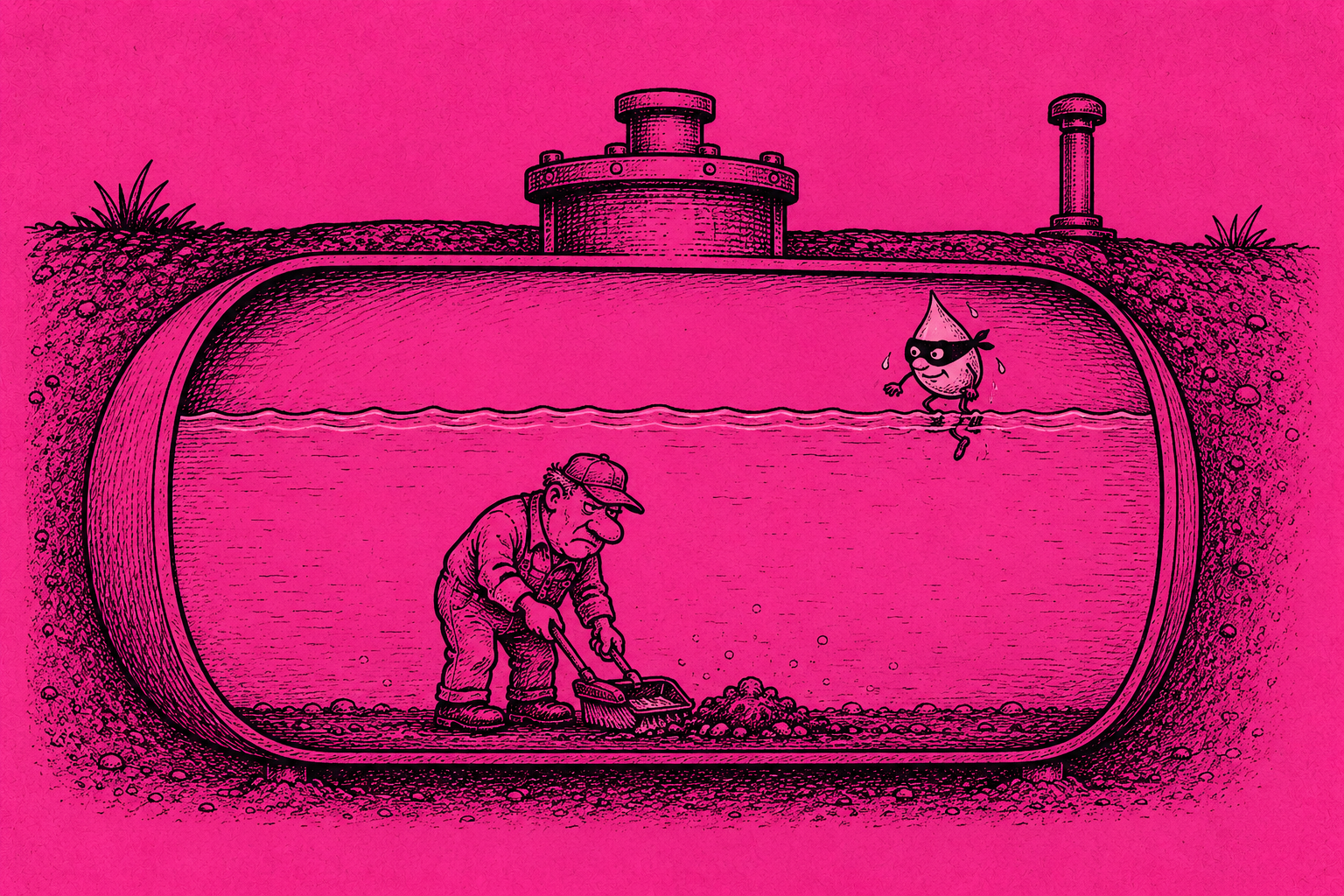
What Actually Happens Inside a Fuel Tank?
Most people think a fuel tank is a passive container. It isn’t. It’s an active chemical environment where fuel ages, water accumulates, biological organisms grow, and sediment forms — and understanding it changes how you think about fuel quality.
A fuel tank — whether it’s the 60-litre polymer shell under your bakkie or a 50,000-litre underground steel vessel beneath a forecourt — is not simply a bucket. From the moment fuel enters it, a set of physical and chemical processes begins. Some are slow. Some depend on temperature. Some require water. Some are biological. None of them are good for your engine or your equipment. This is what’s actually happening in there.
Condensation — The Myth, The Mechanism, and When It’s Actually Real
The advice to “keep your tank full to prevent condensation” is decades old. The engineering behind it has changed substantially.
The condensation advice originates from an era of carburettor-fed, vented fuel tanks. In those vehicles, the vapour space above the fuel communicated directly with the atmosphere through a simple vent. On a warm day, humid air would enter. At night, temperatures dropped, the dew point was reached, and water vapour in that air condensed onto the cold metal walls of the tank. With a half-empty tank, there was more vapour space, more air volume, and more condensation potential. Keeping the tank full left less space for air. The advice was physically correct for that era.
Modern fuel-injected vehicles have sealed evaporative emission control systems (EVAP). The vapour space above the fuel is connected not to the open atmosphere, but to a charcoal canister — a sealed vessel of activated carbon that captures hydrocarbon vapour. The tank breathes through this canister, and the atmosphere inside is saturated with hydrocarbon vapour, not humid outside air. This fundamentally changes the condensation picture.
“Keep your tank full to prevent condensation” (in modern vehicles)
On any post-1990s fuel-injected vehicle with an intact EVAP system, the vapour space above the fuel is not occupied by humid atmospheric air. It contains hydrocarbon vapour. Water vapour from the outside cannot condense from what isn’t there. A properly sealed modern vehicle tank does not meaningfully accumulate condensation water regardless of fuel level. This advice is a legacy instruction that has largely outlived the engineering conditions that made it valid.
Caveat: if the fuel cap seal is degraded, the EVAP charcoal canister is saturated or cracked, or the purge valve fails in the open position, atmospheric air can enter — and the condensation mechanism becomes relevant again. This is not theoretical; aged vehicles with worn seals are genuinely susceptible.
“Keep your tank full” for long-term storage
For classic cars, seasonal equipment, generators, and vehicles stored for months at a time, a full tank remains the correct advice — but for a different reason than condensation. A nearly empty tank exposes more of the fuel surface area to oxidation from residual air in the system, accelerating gum and varnish formation. On steel tanks (common on older vehicles and fuel equipment), the exposed metal above the fuel line is vulnerable to surface rust. A full tank minimises both. The reason changed; the conclusion didn’t.
Condensation in underground storage tanks
Underground storage tanks (USTs) at fuel stations are not sealed systems in the same way. They breathe through pressure/vacuum vents and vapour recovery lines, and the large volume of vapour space — thousands of litres — is subject to temperature cycling. Soil temperature at tank depth varies seasonally; the liquid fuel temperature varies with delivery cycles (incoming fuel at a different temperature to stored fuel). This cycling drives real condensation at the tank walls and roof. Water bottom accumulation in USTs is a routine management concern, not a theoretical one. Every operating forecourt draws periodic water samples from the lowest point of each tank precisely because this happens.
Ethanol absorbs water — and this is more important than condensation
South African petrol grades now contain ethanol (up to 10% in E10 blends). Ethanol is hygroscopic — it actively absorbs water vapour from any gas-phase contact, not just from condensation events. Over time, even in a properly sealed modern tank, trace moisture absorbed by the ethanol component accumulates. When the dissolved water content in E10 petrol reaches approximately 0.3–0.5% by volume, phase separation occurs: the ethanol drops out of solution along with the water, creating a distinct water-ethanol layer at the bottom of the tank. This layer has very low energy content and is directly corrosive to ferrous components. Phase separation is a slow-burn fuel contamination mechanism that condensation advice alone does nothing to address.
Water Contamination — Where It Comes From and What It Does
Water and fuel are chemically incompatible. The ways water finds its way in — and what happens next — are more varied than most people expect.
Petrol and diesel are both hydrophobic — they do not dissolve in water, and water does not dissolve in them. When water enters a fuel tank, it does one of two things: it either sinks to the lowest point as free water (because water is denser than both fuels), or it remains suspended as microscopic droplets in a fuel-water emulsion, which forms when the tank is agitated. In either state, water in a fuel tank causes a cascade of problems with escalating severity.
How Water Gets In
The entry routes are multiple. In vehicle tanks: phase separation from ethanol-blend fuels (described above); trace water delivered in contaminated fuel from the supply chain; degraded fuel cap seals allowing rainwater ingress; and in older vehicles, direct condensation. In underground storage tanks at fuel stations: condensation from temperature cycling; water delivered with fuel (settling in tanker bottoms if tanks are not properly maintained by the distributor); cracked fill point seals allowing surface water entry during heavy rain; and in coastal areas, elevated ambient humidity increasing condensation rates at vent lines. South Africa’s summer rainfall patterns — intense, short downpours followed by high humidity — create periodic elevated water ingress risk at above-ground fill points.
What Free Water Does to Petrol Systems
In petrol, free water sitting at the tank bottom is initially inert — but only until the ethanol in E10 petrol contacts it. Ethanol preferentially migrates to the water layer, causing phase separation. The resulting water-ethanol mixture (often 50–80% ethanol by the time equilibrium is reached) is then drawn into the fuel system if the pickup tube reaches the bottom of the tank. This mixture has a very low octane equivalent, very low energy content, and high water content. Combustion is rough, engine management systems compensate erratically, and the acidic by-products of incomplete combustion accelerate metal corrosion in the fuel injectors and combustion chamber. The water-ethanol layer also causes severe corrosion of steel tank walls and ferrous fuel system components.
What Free Water Does to Diesel Systems
Water in diesel has three distinct damage mechanisms. First: emulsified water droplets reaching a high-pressure common-rail injector (operating at 1,600–2,500 bar) flash to steam instantaneously when injected into the hot combustion chamber. The volumetric expansion of water to steam at these temperatures is explosive — the steam hammer effect erosively damages the injector nozzle tip at the microscopic level, degrading the spray pattern permanently. Second: water at the diesel-fuel interface creates the ideal environment for Hormoconis resinae and associated bacteria — the organisms collectively called diesel bug — which live exactly at that interface. Third: water accelerates oxidative corrosion of all ferrous surfaces in contact with diesel, including tank walls, pipework, and filter housings.
Diesel Bug — Microbial Contamination
Diesel bug is not folklore. Hormoconis resinae is a filamentous fungus that metabolises the hydrocarbon compounds in diesel as a carbon source, living at the fuel-water interface where it has access to both the hydrocarbons it feeds on and the water it needs. It produces a visible black-brown biomass — a slimy mat — along with organic acids as metabolic by-products. These acids are directly corrosive to tank walls. The biofilm physically blocks fuel filters, causing pressure drop warnings and fuel starvation. Treatment involves a registered biocide (such as Biobor JF, a 2-ethylhexyl borate compound commonly used in commercial diesel applications) combined with complete removal of the free water layer that sustains the colony. Removing the biofilm without removing the water achieves nothing; it regrows from the surviving water-resident cells within weeks. South Africa’s warm, humid climate — particularly in coastal regions and during summer — is closer to optimal for diesel bug growth than the cool North Sea conditions where much of the early diesel bug research was conducted.
Sediment — What Accumulates at the Bottom of Every Tank
Fuel is not a clean liquid when it arrives, and it doesn’t stay clean while it sits. Sediment has multiple origins, and each has a different implication for the fuel system downstream.
The phrase “fuel sediment” covers a surprisingly wide range of materials, each with a different origin and different consequences. In an underground storage tank, sediment accumulates at the rate of grams per day from multiple simultaneous sources. In a vehicle fuel tank, the sediment load is lower but no less consequential — because the entire sediment burden eventually passes through a filter system calibrated to protect injectors that cost thousands of Rands each.
Inorganic Particulates — Rust, Scale, and Pipeline Debris
Steel tanks — older vehicle tanks, underground storage tanks, farm storage tanks — corrode from the inside wherever water and oxygen coexist. The rust particles (iron oxides, primarily Fe₂O₃ and Fe₃O₄) shed from the tank walls and settle on the tank floor. During a busy forecourt’s refuelling cycle, when 30,000 litres of fresh fuel arrives via road tanker, the agitation disturbs years of settled sediment and suspends it throughout the tank. Every vehicle that refuels in the 15–30 minutes after a tanker delivery is drawing slightly more sediment-laden fuel than usual. This is not a catastrophic problem for vehicles with intact fuel filters — but it is exactly why fuel filter replacement intervals exist. Pipeline scale (mineral deposits from water in the supply chain) and metal fines from pump wear also contribute to inorganic sediment loads.
Wax Precipitation in Diesel
Diesel fuel contains paraffin wax compounds — long-chain alkanes that are in solution at normal operating temperatures. As temperature drops, these waxes crystallise out of solution. The temperature at which wax crystals first appear is called the Cloud Point (because the fuel turns visibly cloudy). The temperature at which the wax crystals form a gel that prevents fuel flow is the Cold Filter Plugging Point (CFPP). South African summer diesel is typically not formulated for sub-zero CFPP performance — the local climate doesn’t demand it for most of the country. However, vehicles travelling to Lesotho, the high Drakensberg, or the Northern Cape in winter can encounter temperatures approaching the CFPP of local diesel formulations. Wax crystals are a reversible sediment — warming the fuel dissolves them — but in a blocked filter at the roadside in the Karoo at 2 a.m., this is cold comfort.
Biological Sludge from Diesel Bug
The biofilm produced by Hormoconis resinae and associated bacteria is a thick, dark, gelatinous material — heavier than diesel, so it settles to the bottom and collects in sumps. It is highly effective at blocking fuel filters and fuel-water separators. Unlike rust sediment, which passes through filtration and accumulates on filter media over weeks, biological sludge can form a coherent mass that physically bridges across filter elements and causes sudden, near-total fuel flow restriction. Tanks with an established diesel bug colony require mechanical cleaning — not just biocide treatment — to remove the accumulated biomass before it migrates downstream.
Oxidative Gum and Polymer Residue
Fuel ageing (covered in detail in the next section) produces gum and varnish from the oxidation of unstable hydrocarbon compounds. These oxidation products are semi-solid to solid at fuel system temperatures, and they either remain dissolved in the fuel until combustion (where they produce hard carbon deposits on injectors, intake valves, and combustion chamber surfaces) or precipitate as visible sediment in the tank bottom. Petrol is more prone to gum formation than diesel. Ethanol-blend petrols are particularly susceptible because ethanol oxidises to acetaldehyde and acetic acid — contributing to both gum formation and increased fuel acidity. Sediment from fuel oxidation has a characteristic dark brown to black colour and a resinous texture quite distinct from rust or biological sludge.
Fuel Ageing — The Chemistry of Slow Deterioration
Fuel is not shelf-stable. It begins degrading the moment it leaves the refinery, and the timeline is shorter than most people assume.
Both petrol and diesel are complex mixtures of hundreds of different hydrocarbon compounds. They are not chemically stable indefinitely. The refinery adds antioxidant packages — compounds such as hindered phenols (butylated hydroxytoluene, for example) and phenylenediamines — to slow oxidative degradation. These additives are consumed over time. Once depleted, the underlying hydrocarbons begin reacting with dissolved oxygen, UV light, heat, and water to form progressively more complex and less desirable products.
Petrol Oxidation — Gum, Varnish, and Peroxides
Petrol contains a significant proportion of olefins (alkenes) — unsaturated hydrocarbons with double carbon bonds that are particularly reactive with oxygen. Oxidation of olefins produces hydroperoxides, then alcohols, aldehydes, carboxylic acids, and ultimately gum (a collective term for the high-molecular-weight polymerisation products of oxidative degradation). The ASTM D381 test measures existent gum in mg per 100 ml of fuel. Fresh petrol from a refinery typically shows washed gum content well below 5 mg/100 ml. After 6–12 months of storage without stabiliser, this figure increases significantly, and the gum deposits on intake components, injector tips, and combustion chamber surfaces as a brown-to-black varnish. Gum deposits on fuel injectors alter the spray pattern, causing incomplete atomisation and rich-burn misfires.
Petrol Vapour Pressure Change and Ethanol Evaporation
Petrol is a blend formulated to a specific Reid Vapour Pressure (RVP) for each season and region — the vapour pressure determines cold-start performance and hot-weather vapour lock resistance. As petrol ages in storage, the lightest, most volatile fractions (C₄–C₅ compounds, butanes, pentanes) evaporate preferentially from even a nominally sealed tank. This shifts the RVP of the remaining fuel and changes its octane characteristics. Ethanol — which has lower vapour pressure than the lightest petrol fractions but much higher water affinity — becomes proportionally more concentrated as the tank ages and the light fractions leave. Stale petrol in a generator or classic car can exhibit hard starting, rough running, and poor throttle response entirely from this vapour pressure shift, independent of any gum formation.
Diesel Oxidation and FAME Instability
Diesel is generally more oxidatively stable than petrol over a given storage period — its heavier, more saturated hydrocarbon composition is less reactive with oxygen than petrol’s olefin content. However, South African diesel supplied under SANS 342 contains up to 5% FAME (Fatty Acid Methyl Esters — biodiesel derived from vegetable oils). FAME is substantially less oxidatively stable than mineral diesel. FAME oxidises to form peroxides and then acidic degradation products; it polymerises to form gum-like residues; and it is strongly hygroscopic, drawing water moisture into the diesel blend. Diesel with a high FAME content has a practical storage life of 6–12 months without antioxidant treatment. Mineral diesel alone can be stored for 12–24 months in appropriate conditions. The blended product falls between these limits — closer to the lower end if stored in warm, partially full tanks with any water present.
Thermal Degradation in High-Pressure Injection Systems
Modern common-rail diesel injection systems expose the fuel to extreme pressure and temperature cycling — fuel is pressurised to 1,600–2,500 bar in the high-pressure pump, partially injected, and the remainder returns to the tank via a return line at elevated temperature (50–80°C above ambient in some systems). This return fuel is thermally stressed: dissolved oxygen has reacted, peroxides have formed, and the antioxidant package has been partially consumed by the heat history. This fuel cycles through the system repeatedly before being used. High-pressure common-rail systems therefore create a micro-environment of accelerated fuel ageing in their own return circuits — the fuel in a vehicle that has sat unused for a month, then been started several times, may be more degraded than its calendar age would suggest.
South Africa: Warm Temperatures Accelerate Everything
Fuel degradation rates are strongly temperature-dependent. The Arrhenius relationship in chemistry states that reaction rates roughly double for every 10°C increase in temperature. South African ambient temperatures — particularly in the Northern Cape, Lowveld, and Gauteng summer — regularly exceed 35–40°C. Fuel stored in above-ground tanks exposed to direct solar radiation can reach temperatures of 45–55°C. At these temperatures, oxidative degradation, gum formation, and microbial growth all proceed at rates 4–8× faster than they would in a cool European storage environment. Fuel quality standards and storage guidelines developed in temperate climates require recalibration for the South African context. A 12-month storage rating for diesel in Germany may represent 3–4 months in a sun-exposed farm tank on the Highveld.
This is particularly consequential for farms, construction sites, and any operation using bulk diesel storage. Tanks that are slow to turn over — where fuel sits for months between top-ups — need active fuel management: regular water draws, fuel testing, and stabiliser additives to compensate for what the climate accelerates.
Why Fuel Stations Monitor Their Underground Tanks
The tank under a forecourt is the most tightly monitored vessel in retail fuel. There are good reasons for every sensor in it.
An operating service station in South Africa may hold 100,000–200,000 litres of fuel in underground tanks at any given time. These tanks are below the forecourt, typically at a depth of 1–3 metres, and the public — driving over them daily — has no awareness of the processes being actively managed beneath the surface. Automatic Tank Gauging (ATG) systems — the most common being Veeder-Root TLS series equipment — continuously monitor every parameter that matters. None of this monitoring is optional, and none of it is bureaucratic box-ticking.
Leak Detection
A slow leak from an underground storage tank — as small as 0.4 litres per hour — will not be visible at surface level. Petrol and diesel are both classified as Light Non-Aqueous Phase Liquids (LNAPLs): they float on groundwater, spread laterally as a free-phase layer, and contaminate groundwater at concentrations that are harmful to human health at parts-per-billion levels. Benzene, a component of petrol, is a known carcinogen with a drinking water standard of 1 microgram per litre (1 ppb) under South African regulations. A slow UST leak, undetected for a year, can contaminate a groundwater plume extending hundreds of metres from the site. ATG systems perform statistical leak detection tests during overnight periods of no dispensing — comparing expected fuel volume against measured volume, corrected for temperature, to identify anomalous losses. Under South Africa’s National Environmental Management Act (NEMA) and local authority requirements, operators bear liability for groundwater contamination. The monitoring exists because the legal and environmental consequences of not detecting a leak are severe and expensive.
Temperature Compensation for Accurate Inventory
Petrol and diesel expand and contract measurably with temperature. Petrol’s coefficient of thermal expansion is approximately 0.00095 per °C — which means a 50,000-litre tank will show an apparent volume change of nearly 500 litres across a 10°C temperature swing, with no fuel having entered or left. Without temperature correction, inventory reconciliation is impossible. ATG systems record fuel temperature continuously and report volumes corrected to a reference temperature of 15°C — the international standard. This temperature-corrected volume is what is billed to motorists, what is declared to SARS, and what is used to verify tanker deliveries. A tanker delivering 30,000 litres of fuel at 32°C on a summer afternoon is actually delivering slightly less than 30,000 litres at 15°C standard. The ATG system reconciles this automatically. Without it, operators would be systematically overbilling or underbilling on every transaction depending on the season.
Water Bottom Monitoring
ATG probes include water-sensing floats or capacitance sensors at the bottom of the measurement probe. These detect free water accumulation in the tank sump with millimetre accuracy. A rising water bottom reading is an early warning signal for several problems simultaneously: possible tank or fill-point seal failure allowing surface water ingress; condensation accumulation requiring scheduled drain-off; or delivery of contaminated product from a supplier whose own tank or tanker has a water issue. Industry practice sets maximum acceptable water bottoms — typically 25–50 mm depending on tank diameter and product type — above which the operator must arrange tank draining before water reaches the draw-off point and enters the dispenser. ATG water alarms are among the most actionable early warnings in day-to-day forecourt management.
Delivery Verification and Theft Detection
South Africa has a well-documented fuel theft problem at multiple points in the supply chain — from tanker meter manipulation to underground tank bypass and site-level dispensing fraud. ATG reconciliation is the primary technical defence. Every tanker delivery is logged against the ATG’s before-delivery and after-delivery readings. Discrepancies outside acceptable tolerance (typically ±0.5% of delivery volume) trigger investigation. Similarly, daily sales reconciliation — dispensed volume from pump meters versus ATG tank level drop — identifies unexplained losses that may indicate product diversion, meter tampering, or tank integrity issues. Operators using manual dipstick measurement instead of ATG systems are significantly more vulnerable to loss-in-transit claims and dispenser-level fraud, because manual measurement is too imprecise for early discrepancy detection at commercially meaningful volumes.
Overfill and Vapour Space Management
Underground tanks are not filled to capacity. A vapour space — typically 5–10% of tank volume — is maintained above the fuel level to accommodate thermal expansion of the fuel and to provide a buffer for vapour recovery systems. Overfilling a UST forces product into the vapour recovery lines, the fill point sump, and potentially into the soil at the fill adapter — a regulatory violation and an environmental incident. ATG systems provide high-level alarms during deliveries that warn tanker operators before the tank approaches capacity. In a busy forecourt taking multiple deliveries per week across several product tanks, the ATG’s overfill protection function runs continuously in the background of every delivery. It is not glamorous engineering. It is the kind of engineering that prevents expensive, legally consequential incidents.
What the Tank Is Actually Doing
A fuel tank is a chemically dynamic environment. From the moment fuel enters it, the following processes run simultaneously and continuously:
- Oxidation Unstable hydrocarbons react with dissolved oxygen, producing gum, varnish, and acidic degradation products. Temperature accelerates this significantly — a major concern in the South African climate.
- Water Accumulation Free water settles to the bottom via condensation, phase separation from ethanol blends, or supply chain contamination. Even small quantities — tens of millilitres — can initiate biological growth in diesel.
- Microbial Growth In diesel tanks with any free water present, Hormoconis resinae and associated bacteria colonise the fuel-water interface within weeks under warm conditions. The resulting biofilm blocks filters and corrodes metal surfaces.
- Sediment Accumulation Rust, pipeline scale, wax crystals, biological sludge, and oxidative gum settle progressively at the tank bottom. Every agitation event — a delivery, a vehicle bump, a pump cycle — resuspends some of this sediment.
- Evaporation The lightest fuel fractions leave through the vapour space, shifting the fuel’s vapour pressure and octane/cetane characteristics over time. Ethanol concentrations in the liquid phase increase as lighter fractions preferentially leave.
The engineering response to all of this — in vehicle tanks, it’s the multi-stage fuel filter system and the EVAP canister; in underground storage tanks, it’s the ATG, the sump monitoring, the water draw procedures, and the delivery reconciliation protocols — exists precisely because ignoring these processes is not an option. The processes are always running. The question is only whether you are managing them.