
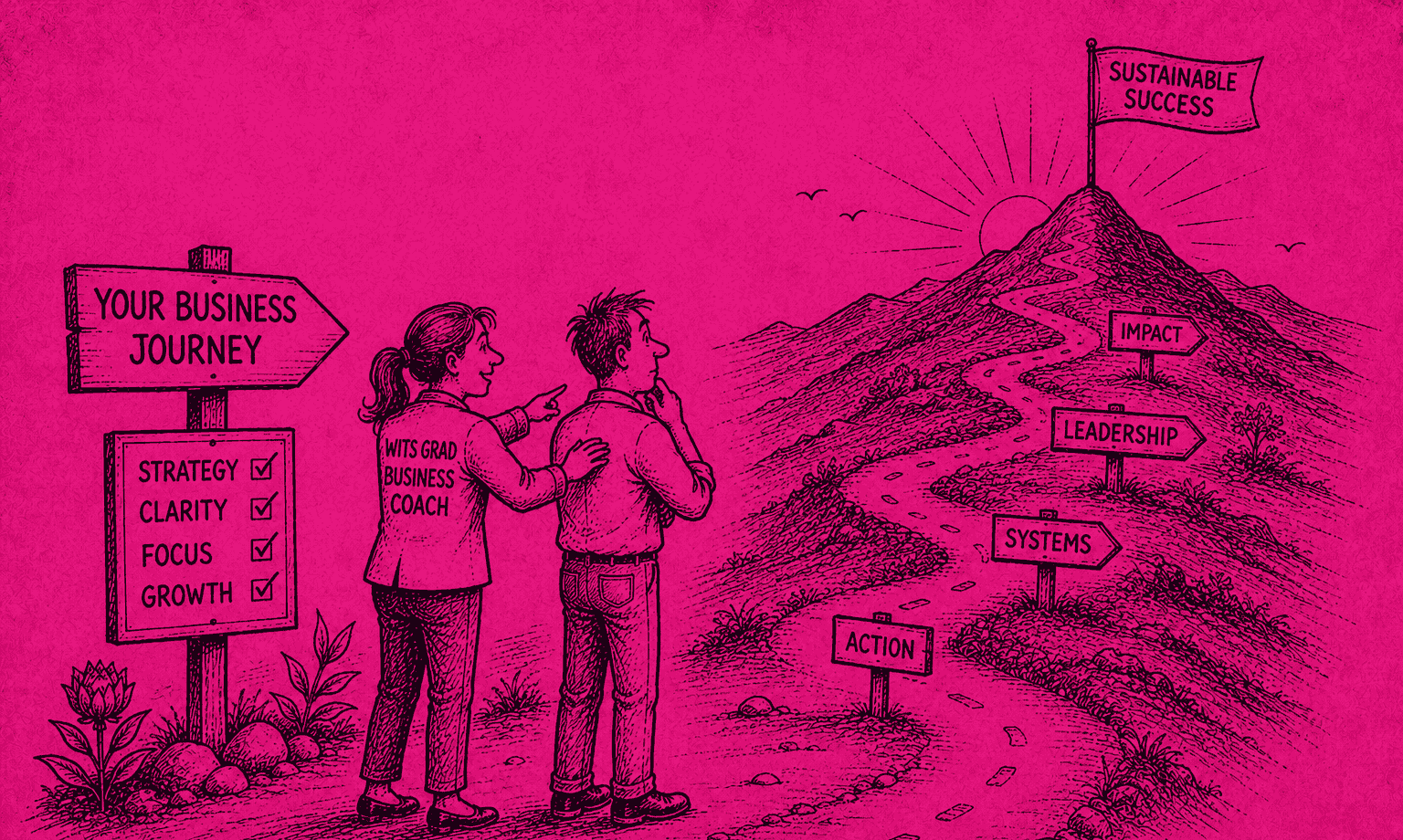
Your Strategy Is Fine. Your Thinking Is the Problem.
Most struggling businesses do not have a strategy problem. They have a thinking problem. The plan exists. The market opportunity exists. The resources, more often than not, are available or accessible. What stands between where a business owner is today and where they want to be is rarely a missing piece of information. It is a set of deeply ingrained mental habits that quietly sabotage good decisions, block action, and keep capable people in cycles they do not fully understand.
This is not motivational conjecture. It is what neuroscience and behavioural psychology have been documenting for decades — and it is what three decades of working with South African business owners has confirmed at close range.
The Science of Why Smart People Get Stuck
The human brain is not designed for optimal business decision-making. It is designed for survival. That distinction matters more than most people realise.
Your brain runs on efficiency. It builds mental shortcuts — called cognitive schemas — that allow it to process familiar situations quickly without burning excessive energy. This is useful when navigating routine tasks. It becomes a liability when those shortcuts are built on old experiences, false assumptions, or environments that no longer exist. The brain applies yesterday’s logic to today’s problem, and calls it instinct.
This is compounded by the way the brain responds to perceived threat. When a business decision carries significant risk — a new market, a large investment, a difficult conversation with a client or partner — the amygdala, the brain’s threat-detection centre, can trigger a stress response that narrows cognitive function. Research into how cortisol and adrenaline affect the prefrontal cortex — the part of the brain responsible for long-range planning and rational judgement — consistently shows that under moderate to high stress, the quality of complex decision-making deteriorates. Business owners operating in genuinely difficult environments are, physiologically, not thinking at their best precisely when clear thinking matters most.
The brain applies yesterday’s logic to today’s problem, and calls it instinct.
Add to this the well-documented phenomenon of loss aversion — established through decades of research in behavioural economics, most prominently by psychologists Daniel Kahneman and Amos Tversky — which shows that the psychological pain of losing something is roughly twice as powerful as the pleasure of gaining something of equivalent value. For business owners, this translates directly into a chronic bias toward avoiding risk over pursuing opportunity, even when the opportunity is objectively the better choice.
None of this is character weakness. It is biology. The question is whether you are aware of it — and whether you have tools to work with it rather than against it.
The Research That Changed How We Think About Thinking
Three bodies of science underpin effective mindset coaching at the professional level. Understanding what they are — not just that they exist — is part of what makes the work credible.
The brain physically rewires itself in response to repeated thought patterns and behaviours. Neural pathways that are used frequently become stronger and faster. Those that are abandoned weaken over time. This is not metaphor — it is measurable structural change. It means that thinking habits are not fixed personality traits. They are modifiable, given the right conditions and consistent practice.
Psychologist Carol Dweck’s decades of research demonstrated that people broadly hold one of two beliefs about their own abilities: that they are fixed and innate, or that they can be developed through effort and learning. Individuals with a growth mindset consistently outperform those with a fixed mindset in challenging, novel environments — not because they are more talented, but because they respond differently to failure, feedback, and difficulty.
Bandura’s research showed that a person’s belief in their own capacity to execute a specific task is one of the strongest predictors of whether they will attempt it, persist through difficulty, and ultimately succeed. Self-efficacy is not general confidence — it is task-specific, and it is built through structured experience, observation of others succeeding, and the quality of encouragement from credible sources. It is directly coachable.
The relationship between thoughts, emotions, and behaviours is not one-directional. Thought patterns drive emotional states, which drive behaviour — but the reverse is also true. Changing habitual thought patterns through structured challenge and reframing produces measurable changes in both the emotional response to situations and the quality of subsequent decisions. This is the practical mechanism behind most evidence-based coaching interventions.
The Obstacles South African Business Owners Face Specifically
Every market has its own texture. South Africa’s business environment is not generic, and the mindset obstacles that surface most consistently here reflect that. They are worth naming plainly.
-
01Hypervigilance Disguised as Caution
Operating in an environment of genuine instability — fluctuating energy supply, currency volatility, inconsistent policy — teaches the nervous system to stay on high alert. Over time, this appropriate response to real risk becomes an indiscriminate brake on all forward movement. Business owners become expert at identifying what could go wrong and increasingly unable to commit to what could go right. The threat response is stuck in the on position.
-
02Learned Helplessness in Structural Adversity
When external obstacles are repeatedly encountered and consistently outside one’s control — regulatory bureaucracy, access to finance, infrastructure failures — the brain draws a generalised conclusion: effort does not reliably produce outcomes. This is what psychologist Martin Seligman documented as learned helplessness. In a business context it presents as chronic procrastination, low initiative, and a persistent sense that the game is rigged. It is a rational response to irrational conditions — and it can be unlearned.
-
03Isolation at the Top
South African SME owners — across every sector and demographic — disproportionately carry strategic, operational, and personal pressures simultaneously and alone. The decision-making isolation of running a small or medium business compounds cognitive load and amplifies every bias listed above. Research on decision fatigue consistently shows that the quality of choices deteriorates as the volume of unresolved decisions accumulates. Most business owners are making their most important decisions at the bottom of their cognitive reserves.
-
04Identity Fusion with the Business
When a business owner’s self-worth is tightly fused with the performance of the business, every setback becomes a personal indictment. This is not merely uncomfortable — it is cognitively distorting. It makes objective analysis of problems nearly impossible, because what is required is the capacity to look at the business as a system separate from oneself. That separation is a cognitive skill that can be built. Without it, honest diagnosis is replaced by defensiveness.
-
05Confirmation Bias in Strategy
The brain has a well-documented tendency to seek, favour, and remember information that confirms existing beliefs while discounting contradictory evidence. In business strategy, this means that a flawed plan defended with conviction will consistently outcompete accurate market feedback in the business owner’s internal assessment. The business keeps doing what it has always done while interpreting the results as temporary. External perspective is the only reliable corrective.
What Coaching Actually Does — And How
Business coaching is not therapy, and it is not consulting. It occupies a specific and practical space between the two. A consultant analyses your situation and prescribes solutions. A therapist works with your history to understand the present. A coach works with your present thinking to change your future behaviour — grounded in where you are, focused on where you are going, and structured around accountability to the gap between the two.
At the methodological level, effective coaching draws on the science described above. It works through four primary mechanisms.
Most limiting beliefs are invisible to their holder. The first function of structured coaching is to bring them into conscious awareness through disciplined questioning. You cannot challenge an assumption you do not know you are making. A skilled coach asks the question you have been asking yourself in a way that produces a different answer — not by providing the answer, but by changing the angle of enquiry.
The same business situation can be accurately described in ways that produce completely different emotional and behavioural responses. A cash flow problem is a constraint, or it is a prioritisation problem, or it is evidence of a pricing model that needs revisiting. None of these reframes is false — but they produce different thinking and different actions. Reframing is not positive thinking. It is a deliberate cognitive tool for expanding the solution space.
The research on implementation intentions — the specific plans people make about when, where, and how they will perform an action — consistently shows that the probability of follow-through roughly doubles when those intentions are stated to another person who will follow up. Accountability is not about pressure. It is about creating an external structure that compensates for the internal resistance that ambition alone cannot overcome.
Confidence in a domain is not delivered — it is constructed through a sequence of designed experiences that progressively expand what you believe you are capable of doing. Effective coaching does not try to convince people they can do things. It designs the conditions under which they discover they can. The distinction matters enormously for how durable the change turns out to be.
Thirty Years and a Wits Education Later
Academic grounding at the University of the Witwatersrand provides a theoretical foundation. Thirty years of sitting across the table from South African business owners in every sector, size, and circumstance provides something the university cannot: the pattern recognition that only comes from volume and variety.
After enough engagements, you stop being surprised by the specifics and start recognising the architecture underneath. The language changes. The industry changes. The scale changes. The core obstacles — the gap between intention and action, the distorted self-assessment, the decision paralysis at critical junctures — appear with remarkable consistency across all of it.
What that experience produces is not a standard programme delivered uniformly. It produces a calibrated instinct for which intervention is likely to matter most, in which order, for which person — and what to stop doing when a different approach is called for. That is the value of genuine experience: not that it has all the answers, but that it has seen enough of the territory to know which questions to ask first.
Coaching does not fix businesses. It improves the quality of thinking and behaviour of the person running the business. If the business has a structural problem — a broken cost model, a saturated market, a product that is genuinely not viable — better thinking will get you to that conclusion faster and more clearly, which is itself valuable. What coaching will not do is conjure opportunity where none exists. What it will do is ensure that you are not the obstacle standing between your business and the opportunity that does exist.
Why Virtual Delivery Works — And Works Well
There is a persistent assumption that coaching requires physical presence to be effective. The research does not support this. Numerous studies comparing outcomes across in-person and virtual coaching have found no statistically significant difference in coaching effectiveness between the two formats — provided the sessions are structured, consistent, and conducted with appropriate preparation on both sides.
For South African business owners outside major urban centres, the practical barrier of travel has historically excluded access to quality professional development. Virtual delivery removes that barrier entirely. A business owner in Limpopo, the Northern Cape, or the Eastern Cape has access to the same quality of engagement as someone in Sandton — without the travel cost, the lost half-day, or the scheduling friction that causes most coaching relationships to lose momentum before they produce results.
Sessions are conducted via video call, structured around your actual business priorities, and designed to be practically applicable within your current operating context. The work happens in the conversation. The change happens in the decisions and behaviours that follow.
Is This for You?
The honest answer is that business coaching is not for everyone, and it is worth saying so plainly. It requires a willingness to have your thinking examined and challenged. It requires showing up to sessions prepared to engage seriously rather than perform. And it requires a tolerance for the discomfort of discovering that some of what you have believed about your business, your market, or yourself is not quite accurate.
If you are operating a business in South Africa, you are already demonstrating a level of resilience and commitment that most people do not. The question is not whether you are capable. The question is whether the thinking you are currently applying is calibrated to the business you are trying to build — or to the one you started with, in different conditions, under different pressures, with a different understanding of what was possible.
That recalibration is what structured coaching exists to produce. It is not a quick fix. It is a methodical, science-backed process for closing the gap between where your business is and where your ability to run it can take it.