
Why Fuel Costs What It Costs in South Africa
One of the most common questions I hear from clients, fleet operators and everyday motorists is surprisingly simple: “Who actually decides the fuel price?”
The answer is far more scientific than most people expect.
As someone working within the fuel industry through my partnership with FuelZone, and as a Wits graduate with a deep interest in how energy markets shape our economy, I’ve learned that fuel pricing is not driven by a single company, politician, refinery or service station.
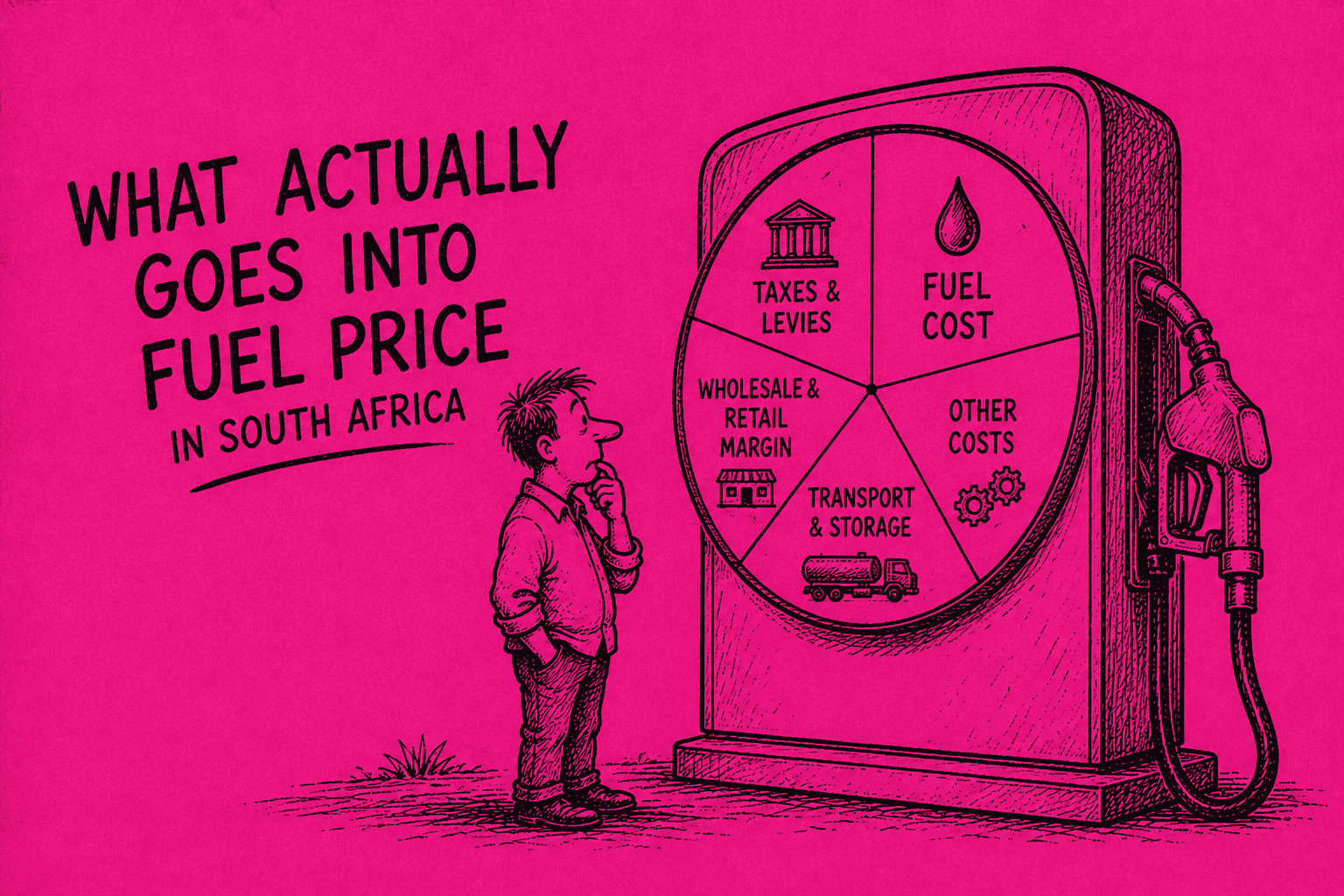
Instead, the final number you see on the pump is the result of a carefully structured system involving global fuel markets, international shipping, currency fluctuations, infrastructure costs, regulatory mechanisms and national levies.
Once you understand the moving parts, fuel prices begin to make a lot more sense.
The Biggest Piece: The Fuel Itself
The biggest misconception I encounter is that fuel prices are based purely on crude oil.
In reality, South Africa largely works from an import-parity pricing model known as the Basic Fuel Price (BFP). Rather than asking what it costs to produce fuel locally, the system effectively calculates what it would cost to purchase refined fuel on international markets and bring it into South Africa.
That international benchmark becomes the foundation of the final pump price.
Why the Rand Matters So Much
This is where things become particularly interesting.
Fuel is traded globally in US Dollars, which means South Africans are exposed to two powerful market forces simultaneously: the international fuel market and the Dollar-Rand exchange rate.
In practice, a stronger Rand can help soften international price increases, while a weaker Rand can amplify them. It is one of the reasons fuel pricing discussions often involve economics, geopolitics and currency markets all at once.
Then Come the Levies
Once the international portion has been calculated, several domestic charges are added to arrive at the final regulated price.
These include the General Fuel Levy, the Road Accident Fund levy, carbon-related charges, pipeline and storage costs, and various regulatory components that support the broader fuel supply chain.
Collectively, these charges often account for roughly a third of the final pump price, although the exact proportion naturally shifts as global fuel prices rise and fall.
Common Components of a Fuel Price
- Basic Fuel Price (international fuel cost)
- General Fuel Levy
- Road Accident Fund Levy
- Carbon-related charges
- Pipeline and storage costs
- Wholesale margins
- Retail margins
- Distribution and transport costs
Interesting Fact
South Africa does not adjust fuel prices every day. Instead, international fuel prices and exchange rates are monitored over a period before official monthly adjustments are made. This helps create a more predictable pricing environment for consumers and businesses.
Why Inland Fuel Costs More Than Coastal Fuel
Fuel has to travel.
A litre sold inland has generally moved further through the country’s logistics network than a litre sold near coastal import infrastructure. Pipelines, storage depots, road transport and operational infrastructure all contribute to the final delivered cost.
This is why fuel pricing includes transport-related differentials that help account for the cost of moving fuel across a country as geographically large as South Africa.
The Part Most People Never Hear About
Behind the scenes, South Africa also uses a balancing mechanism known as the Slate Account.
Because international fuel prices move daily while local fuel prices are adjusted periodically, temporary under-recoveries and over-recoveries can occur. The Slate mechanism helps smooth these differences over time rather than allowing sudden shocks to flow directly into the market.
So What Are You Actually Paying For?
The number displayed on a fuel pump represents far more than the fuel itself.
It reflects global energy markets, refining economics, international shipping, currency fluctuations, national infrastructure, transport logistics, wholesale and retail operations, as well as statutory levies that form part of South Africa’s fuel pricing framework.
Understanding these components helps explain why fuel prices can move even when there appears to be no obvious event happening locally. A change in global demand, a movement in exchange rates, or shifts in international fuel markets can all eventually influence the price paid by South African consumers.
Wits Graduate
In partnership with FuelZone