
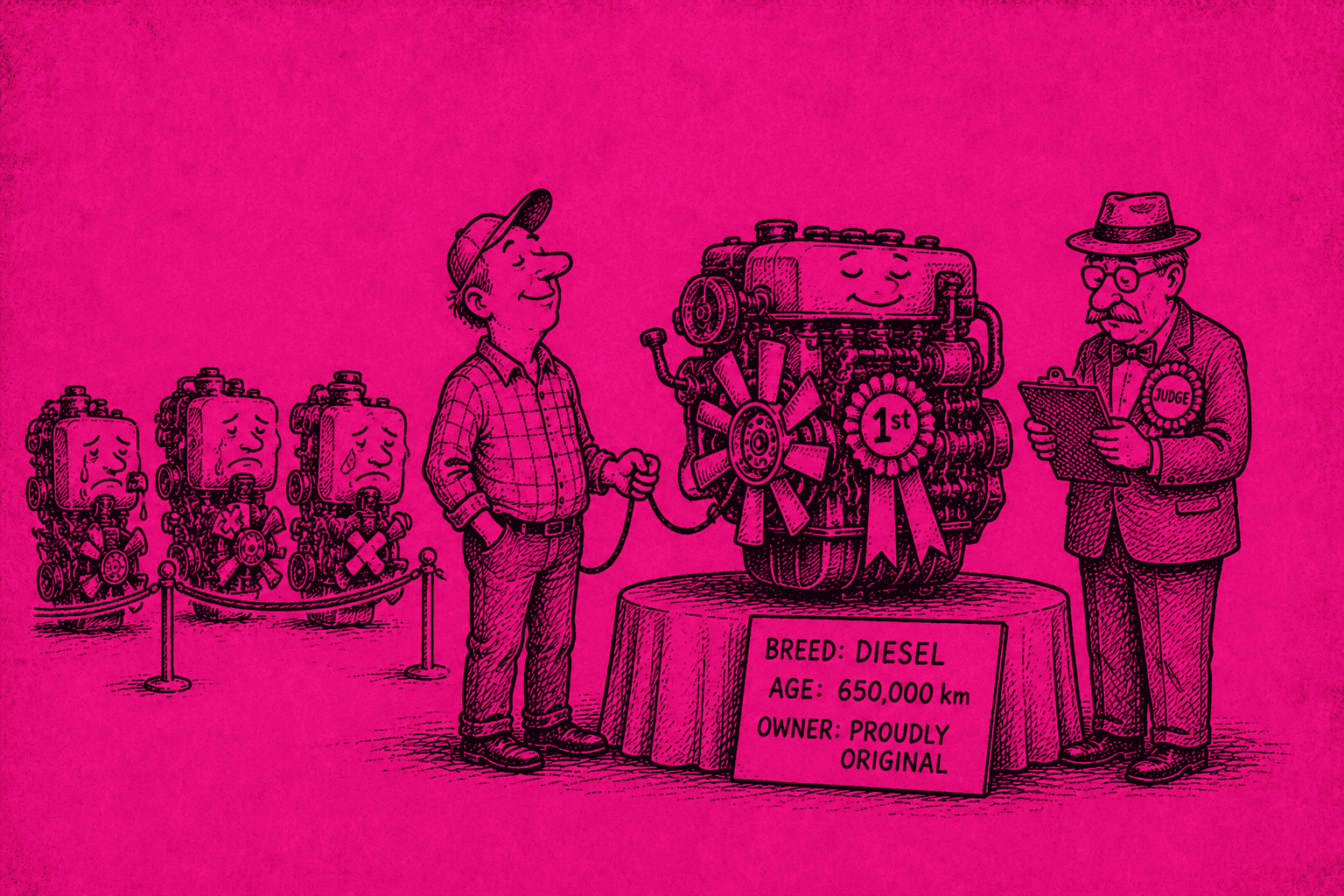
Why Do Diesel Engines Last Longer Than Petrol Engines?
It gets argued about in every workshop, every forecourt, every fleet manager’s office. Here’s what the engineering actually says — including why the answer is more complicated for modern diesels than it used to be.
Ask any long-distance trucker, any commercial fleet operator, or any farmer running a Land Cruiser 70 series across the Karoo, and they’ll tell you the same thing: diesel engines just don’t die. The question worth asking is not whether this is true — it demonstrably is, in many cases — but why it’s true, when it stops being true, and what the modern emissions era has done to a reputation that used to be almost unassailable.
Higher Compression Ratios Force Better Engineering
Diesel engines are overbuilt by necessity — and that overbuild is exactly what makes them last.
Diesel engines compress air to ratios between 16:1 and 23:1 — roughly double that of a comparable petrol engine. This is not optional; compression ignition (the entire premise of how a diesel works) requires this extreme pressure to heat the air charge to approximately 500°C, at which point the injected diesel auto-ignites. No spark plug, no external ignition source. Just physics.
The consequence of generating these pressures inside the engine, hundreds of times per minute, is that every internal component must be designed to survive forces that would destroy a petrol engine’s internals in minutes. This is where the durability story really begins — not in philosophy, but in metallurgy and engineering tolerances.
Thicker Cylinder Walls and Block Casting
Diesel engine blocks are cast with substantially more material — thicker walls, heavier webs between cylinders, more robust main bearing journals. This isn’t a design choice for aesthetics; it’s a structural requirement. The peak cylinder pressures in a diesel during combustion regularly exceed 180–200 bar. A petrol engine typically sees 50–80 bar. The diesel block is essentially a pressure vessel, and it’s engineered accordingly. That same mass that makes diesel engines heavy is the mass that makes them last.
Forged or Cast Steel Crankshafts as Standard
Petrol engines, particularly smaller displacement ones, frequently use cast iron or nodular iron crankshafts — adequate for the forces involved. Most diesel engines — even relatively modest passenger car units like the 2.0-litre common-rail found in countless bakkies and SUVs — use forged steel crankshafts as standard equipment. Forging aligns the grain structure of the steel, producing a crankshaft that resists fatigue cracking over tens of millions of cycles. The crank simply doesn’t fail from cyclic stress the way a cast equivalent eventually would.
Stronger Pistons and Connecting Rods
Diesel pistons are typically forged aluminium alloy with steel or cast iron ring lands, designed to handle the extreme heat of compression ignition. They are heavier, more thermally robust, and built with tighter geometric tolerances than petrol pistons. Connecting rods in diesel engines are similarly heavier — often I-beam section forgings with wider big-end bearings. The bearing surface area is larger, which distributes load and reduces bearing pressure. This is directly why diesel bearings last longer: less force per unit area, over every single combustion cycle.
Lower RPM Means Fewer Wear Cycles — Full Stop
Engine wear is a function of cycles, not just kilometres. Diesel engines accumulate fewer cycles per kilometre, and far fewer over a lifetime.
This is the most mechanically straightforward reason diesel engines last longer, and it is often underappreciated. Engine wear — of piston rings against cylinder walls, of camshaft lobes against followers, of crankshaft journals against bearings — is directly proportional to the number of times these components move against each other under load. More RPM means more contact cycles per minute. Fewer RPM means fewer.
At a steady 120 km/h on the N1 to Cape Town, a typical diesel bakkie cruises at around 2,000–2,200 RPM. A similarly-sized petrol vehicle at the same speed will be turning 3,000–3,500 RPM. Over a 1,400 km Johannesburg–Cape Town run (a perfectly normal South African long haul), that difference compounds into tens of millions of additional wear cycles for the petrol engine.
Redline Comparison and Operating Range
A diesel passenger car or light commercial vehicle typically has a redline of 4,000–4,500 RPM. A petrol equivalent redlines at 6,000–7,500 RPM. This means diesel engines are almost never operating near their mechanical stress limits during normal driving. A diesel running at 2,200 RPM is at roughly 50% of its design ceiling. A petrol engine at 3,500 RPM is at 50–60% of its ceiling. But the absolute difference — 1,300 fewer RPM, sustained over every hour of highway driving — produces a dramatically different wear rate across 300,000 km of service life.
Total Cycle Count Over Engine Lifetime
Consider a diesel engine reaching 500,000 km — not unusual for a Toyota Hilux 2.4 GD-6 in fleet use, or a Isuzu D-Max 1.9 DDTi running highway kilometres. At an average of 2,200 RPM over that distance, the engine has completed approximately 2.2 billion combustion cycles. A petrol engine covering the same distance at 3,200 RPM average has completed over 3 billion cycles — roughly 40% more wear events on every sliding surface in the engine. The difference in component wear at end of life is not marginal; it is structural.
Valve Train and Timing Component Wear
Every camshaft revolution produces valve lift events — opening and closing each intake and exhaust valve against spring pressure. Cam lobes press against followers, followers press against valve stems, springs compress and release. This happens once every two crankshaft revolutions. Lower RPM directly reduces the rate at which this wear accumulates. Diesel cam followers, tappets, and valve seats see proportionally fewer stress cycles per kilometre. In practice, diesel timing chains and valve train components frequently outlast the engine overhaul interval in fleet use, whereas high-revving petrol engines commonly require valve stem seal replacement and cam follower service well before equivalent mileage.
Engine Design Differences That Work in Diesel’s Favour
Beyond compression and RPM, several fundamental design differences give diesel engines a structural durability advantage.
The longevity gap between diesel and petrol is not entirely explained by compression ratios and RPM. The complete picture includes several design-level choices — some deliberate, some incidental — that consistently benefit diesel engine lifespan.
Diesel Fuel Has Inherent Lubricity
Diesel fuel is not merely a combustion medium — it is also a lubricant for the injection system. The fuel pump and injector internals in a diesel engine are lubricated entirely by the diesel flowing through them. Diesel’s natural lubricity (measured as HFRR wear scar diameter — typically below 460 µm for on-road diesel) keeps these precision components operating with minimal wear across hundreds of thousands of kilometres. Petrol has no meaningful lubricity; it is essentially a solvent relative to diesel. This is one reason why petrol in a diesel engine is so catastrophically damaging (the injection system is instantly deprived of lubrication), and it’s why diesel fuel quality has such a direct impact on pump and injector lifespan.
No Ignition System to Wear Out
Diesel engines have no spark plugs, no ignition coils, no distributors, and no high-tension ignition leads. These components in a petrol engine are consumables with finite service lives — spark plugs every 30,000–100,000 km, coils that fail with age, plug boots that crack and arcover. They are also failure vectors: a misfiring cylinder from a failed spark plug means raw petrol entering the exhaust, fouling the oxygen sensor and catalytic converter. In a diesel, combustion is initiated entirely by the physics of compression and fuel injection timing. One entire system — the ignition system — simply does not exist, and therefore cannot wear out or fail.
Higher Thermal Efficiency = Less Waste Heat in the Engine
Diesel engines convert approximately 40–45% of fuel energy into useful work. Petrol engines convert roughly 28–35%. The thermal efficiency gap is significant: the energy that isn’t converted to work has to go somewhere, and in both cases it goes into heat — in the coolant, the oil, and the exhaust. A petrol engine, being less thermally efficient, dumps more waste heat per combustion cycle into the engine structure. Sustained high temperatures accelerate oil degradation, gasket failure, thermal fatigue in aluminium components, and bearing wear. Diesel engines run their components cooler relative to the energy being processed, which contributes directly to component longevity.
Larger Displacement per Power Output
Diesel engines produce their torque at low RPM and typically have larger displacements relative to their power output compared to petrol equivalents. A 2.4-litre diesel producing 110 kW is not a stressed engine — it is a lightly loaded one. The same 110 kW from a 1.4-litre turbocharged petrol engine (increasingly common in the South African new-car market) means that engine is working at or near its design limits during normal driving. Mechanical stress, thermal load, and component fatigue all scale with how hard the engine is working relative to its design capacity. An unstressed diesel architecture compounds its advantages; a stressed petrol architecture compounds its vulnerabilities.
Modern Diesel Myths Worth Addressing
Not everything you’ve heard about diesel longevity is accurate. Some of it was never true. Some of it used to be true and no longer is.
The diesel engine’s reputation for indestructibility was earned by a previous generation of technology — mechanical injection pumps, minimal emissions equipment, simple valvetrains, and robust indirect-injection chambers. Modern passenger car diesels have changed substantially. Here’s where the received wisdom needs updating.
“Diesel engines always outlast petrol engines”
In heavy commercial applications — trucks, buses, generators, agricultural equipment — this is reliably true. In modern passenger cars and light SUVs, particularly those produced post-2010 with full Euro 5/6 emissions equipment, the gap is substantially smaller and in some cases reversed. The emissions hardware that modern diesels carry (DPF, EGR, SCR/AdBlue) introduces failure modes that simply didn’t exist on older engines, and some of these failures are expensive enough to make a diesel less economical to maintain than a petrol equivalent over a 10-year ownership period. The raw engine block lasts. The systems around it often don’t.
“Diesel requires less maintenance”
Older mechanical diesel engines did have simpler maintenance requirements. Modern common-rail diesels are among the most maintenance-sensitive vehicles on the market. Injectors operating at 1,800–2,200 bar require clean, correctly-spec’d fuel. DPFs require active regeneration (which itself can cause oil dilution problems). EGR valves clog with carbon and require periodic cleaning. Timing belts on many diesel engines (as opposed to chains) require replacement at strict intervals — a missed belt service can cause catastrophic interference engine damage. Modern diesel maintenance intervals are often shorter than equivalent petrol engines, and the consequences of missing them are typically more severe.
“Diesel is always cheaper to run”
In South Africa, diesel has been priced above petrol per litre for several years, partly driven by the international diesel demand premium. The efficiency advantage of diesel (roughly 25–30% better fuel economy versus a comparable petrol engine) still produces a running cost advantage over long distances and high annual mileage. But for urban drivers covering under 15,000 km per year on short trips, the efficiency savings don’t offset diesel’s higher service costs and emissions equipment maintenance. The break-even calculation has changed, and it depends heavily on driving pattern.
“High-mileage diesel bakkies are worth buying”
For pre-2015 mechanical or early common-rail diesel bakkies — Hilux 3.0 D-4D, older Isuzu KB 3.0 TDI, Navara 2.5 dCi — high mileage (250,000–400,000 km) with a full service history is genuinely less concerning than the equivalent in a petrol vehicle. These are engines from an era before DPF fitment, with proven long-service histories across South African fleet use. Post-2016 models with DPF systems require more scrutiny: DPF condition, EGR service history, and injector health need to be verified, not assumed. The old “diesel mileage doesn’t matter” rule applies fully to the older generation and partially to newer ones.
Why Some Modern Diesels Don’t Outlast Older Ones
Emissions legislation changed the diesel engine. Not all of those changes were friendly to longevity.
The emissions controls added to diesel engines from approximately 2009 onward — Euro 5, and then Euro 6 standards (which South Africa adopted incrementally under SANS 342 and national vehicle emissions standards) — transformed diesel from a simple, robust combustion machine into one of the most complex powertrains in the passenger car market. The core engine is still durable. What surrounds it is not.
DPF Oil Dilution — The Silent Engine Killer
The diesel particulate filter captures soot from combustion and must be periodically “regenerated” — a process where the ECU injects additional fuel late in the combustion cycle to raise exhaust temperatures and burn off the accumulated soot (above ~600°C). This works well on highway driving. On short urban trips, the exhaust never reaches regeneration temperature, and the DPF fills with soot. When the engine finally attempts a forced regeneration, some of the post-injection fuel washes past the piston rings and into the engine oil. This is called oil dilution. Diesel in engine oil reduces viscosity and degrades lubrication. Repeated dilution events accelerate bearing wear, cam lobe wear, and ring/liner wear — the exact mechanisms that make diesel engines last. The DPF, designed to protect the environment, inadvertently undermines the engine’s longevity when the vehicle is predominantly used for short trips.
EGR Carbon Buildup on Intake Manifolds
Exhaust gas recirculation (EGR) feeds a portion of exhaust gases back into the intake manifold to reduce combustion temperatures and lower NOx emissions. The problem is that exhaust gas carries oil vapour and soot. Over time, these deposit as a thick, hard carbon layer inside the intake manifold, on the intake ports, and on the intake valves themselves. Carbon buildup reduces airflow into cylinders, causing the ECU to compensate with richer fuelling, which increases soot production, which makes the problem worse. Some diesel engines require intake manifold removal and chemical cleaning at 80,000–120,000 km — a job that costs R3,000–R8,000 at a workshop. This is not a lifespan-ending problem, but it is a maintenance requirement that didn’t exist on pre-EGR engines.
High-Pressure Common-Rail Injectors Are Precision Components
Modern common-rail injection systems operate at pressures between 1,600 and 2,500 bar. The injectors are machined to tolerances measured in microns. They are extraordinarily precise and extraordinarily sensitive to fuel quality and contamination. A single tank of substandard diesel — lower lubricity, water contamination, or particulate contamination — can begin scoring injector internals. Injector wear manifests as poor spray pattern atomisation, which produces incomplete combustion, higher soot output, accelerated DPF loading, and rough running. Each injector on a four-cylinder diesel can cost R3,000–R15,000 to replace. A full set of four is a significant repair bill that older mechanical injection engines simply did not generate.
Turbocharger: Every Modern Diesel Has One
Older diesel engines — the naturally aspirated indirect-injection designs that ran until the late 1990s and early 2000s — frequently had no turbocharger. Modern common-rail diesel passenger vehicles are all turbocharged, and many use variable-geometry turbines (VGT) that actively adjust vane angles to optimise boost across the RPM range. These are complex, heat-exposed mechanical components with actuator mechanisms that can stick with carbon deposits. Turbocharger replacement on a modern diesel runs R8,000–R30,000 depending on the application. An engine that might otherwise reach 500,000 km can be written off economically by a turbo failure at 180,000 km. The raw engine block outlasted the emission systems and ancillaries — a hollow victory.
The South African Context: Fuel Quality Matters More Than You Think
South Africa completed its transition to 50ppm ultra-low sulphur diesel (ULSD) under SANS 342, which brought fuel quality broadly in line with Euro 5 standards. This is good news for emissions equipment longevity. The less publicised consequence is that reducing sulphur content also reduces diesel’s natural lubricity — sulphur compounds are lubricity agents. ULSD requires lubricity additives to compensate, and reputable refiners and distributors include these. However, diesel purchased from informal resellers, certain rural areas, or storage tanks with contamination risk may not meet lubricity specifications. In a modern high-pressure common-rail injection system, this difference is measurable in injector and pump wear rates within tens of thousands of kilometres.
This is also why using a reputable fuel source — a branded forecourt with a known supply chain — is not just a brand loyalty choice for commercial fleet operators. It is a direct maintenance decision with engineering consequences.
Diesel vs Petrol Longevity: What the Engineering Actually Shows
| Factor | Diesel | Petrol | Who Wins |
|---|---|---|---|
| Compression ratio | 16:1–23:1 — forces heavy, robust internals | 8:1–13:1 — lighter components, adequate for lower loads | Diesel |
| Highway RPM | ~2,000–2,200 RPM — far below redline | ~3,000–3,500 RPM — closer to design limits | Diesel |
| Fuel lubricity | Diesel lubricates injection system by design | Petrol is a solvent — no lubrication | Diesel |
| Ignition system wear | None — no spark plugs, coils, or leads | Spark plugs, coils, leads — consumable wear items | Diesel |
| Thermal efficiency | 40–45% — less waste heat in the engine | 28–35% — more waste heat per combustion event | Diesel |
| DPF / EGR complexity | Present on all post-2009 passenger car diesels — significant failure risk | 3-way catalyst only — simpler and more reliable | Petrol |
| Short-trip suitability | Poor — DPF cannot regenerate; oil dilution risk | Fine — no minimum operating temperature requirements for emissions hardware | Petrol |
| Injector service cost | R3,000–R15,000 per injector (high-pressure CRDi) | R500–R2,000 per injector (petrol direct injection) | Petrol |
| Expected engine lifespan (fleet use) | 400,000–800,000 km for commercial units; 250,000–400,000 km for modern passenger car | 200,000–350,000 km typical; some modern turbos less | Diesel |
The Honest Answer
Diesel engines last longer than petrol engines because they are physically overbuilt relative to their operating loads, run at lower RPM (accumulating fewer wear cycles per kilometre), use a fuel that inherently lubricates their injection systems, and operate at higher thermal efficiency (producing less destructive waste heat). These advantages are real, measurable, and consistent across decades of fleet data.
The honest qualification is that modern passenger car diesels carry emissions systems that introduce new failure modes, sensitivity to fuel quality, and maintenance requirements that older diesel engines never had. The engine block will likely still outlast a petrol equivalent. Whether the complete vehicle does depends heavily on:
- Use Case Highway-heavy, high-mileage driving gives diesel every advantage. Short urban trips systematically undermine it.
- Fuel Quality South African ULSD from reputable sources is adequate. Contaminated or low-lubricity fuel accelerates injector wear at a rate that can offset all longevity gains.
- Maintenance DPF health, EGR cleanliness, injector condition, and oil change intervals. Modern diesel rewards discipline and punishes neglect more severely than petrol does.
- Vehicle Age Pre-DPF diesels (pre-2009 broadly) earn the indestructible reputation without qualification. Post-2016 diesels with full Euro 5/6 equipment need more nuanced evaluation.
A well-maintained modern diesel in appropriate use still outlasts a petrol equivalent. The margin has narrowed. The conditions attached to it have grown. Understanding those conditions is the difference between buying a reliable workhorse and an expensive disappointment.