
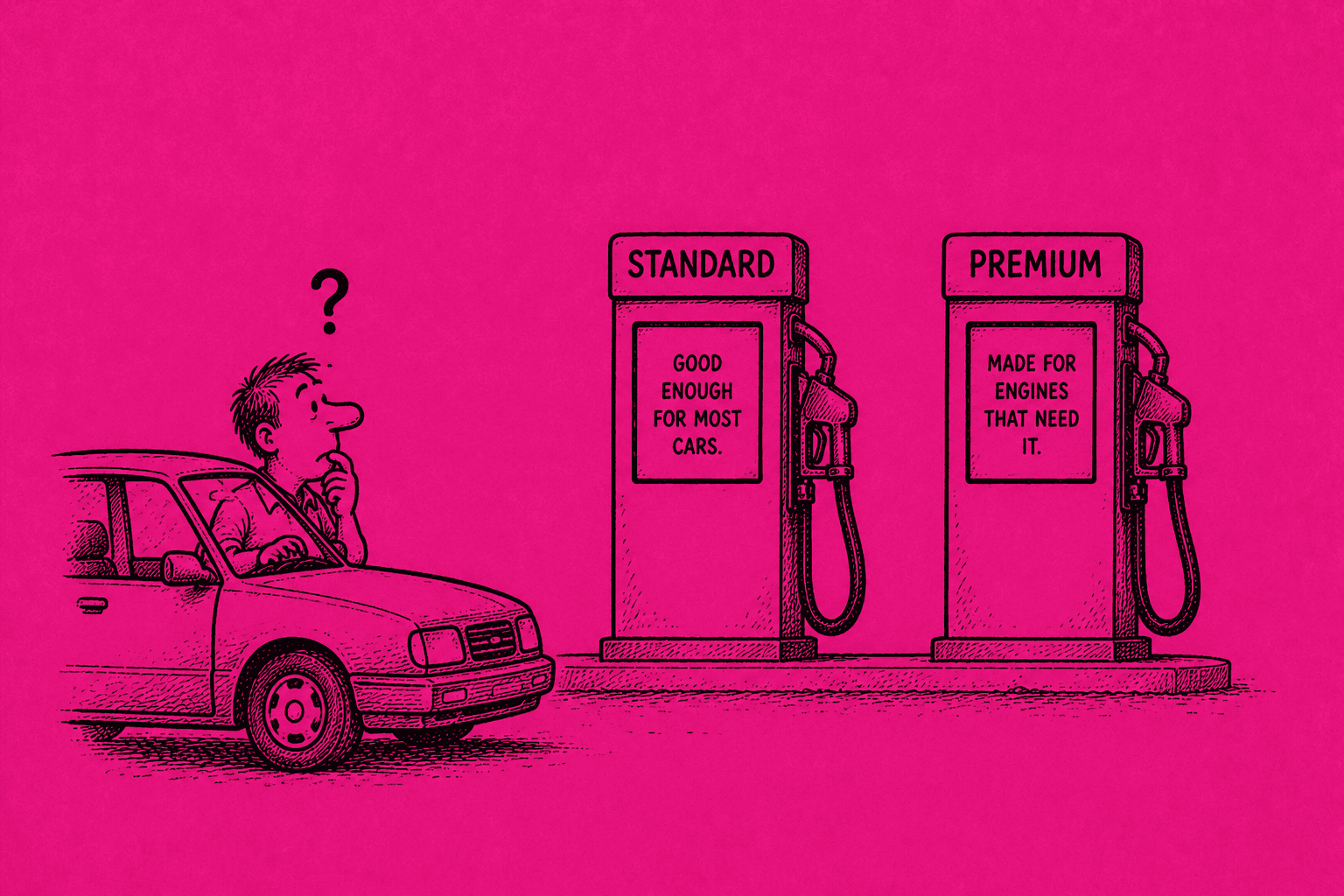
Why Premium Fuel Exists (And Whether Your Car Needs It)
The answer is not “premium is always better.” For many cars, it’s money straight down the drain. For others, running standard fuel is actively harming the engine. The difference is in the engineering.
Premium fuel is one of the most misunderstood products at a South African forecourt. Drivers either assume it’s always worth paying for — marketing implying “premium” means “better” — or they dismiss it entirely as a scam. Neither position is correct. The real answer depends on one thing: what compression ratio and fuel management system your specific engine was designed for.
What the Octane Number Actually Means
Not energy. Not power. One thing only.
The RON figure — Research Octane Number — measures a fuel’s resistance to auto-ignition under compression. That’s it. It does not measure energy content, cleanliness, or how fast the fuel burns. A 95 RON fuel contains almost exactly the same energy per litre as 93 RON. What it does differently is resist igniting until the spark plug tells it to.
Why does that matter? Because petrol engines compress the fuel-air mixture before igniting it. The higher the compression, the hotter the mixture gets during that compression stroke — and a hot, highly compressed mixture will spontaneously ignite if the fuel isn’t resistant enough to hold on until the spark fires. The RON number is the measure of that resistance.
The American labelling confusion: US fuel stations show numbers like 87, 89, and 93. These are AKI ratings — the average of RON and MON (Motor Octane Number). US 87 is roughly equivalent to South African 93 RON. This trips people up constantly when reading American automotive advice online or running imported vehicles. The methodology differs; the fuel quality is broadly comparable at the same tier.
Knock and Pre-Ignition — What Goes Wrong
Two related problems. Both destructive. Only one is correctable by the ECU.
Knock (Detonation)
The spark plug fires and a flame front begins spreading across the combustion chamber. In a correctly fuelled engine, this combustion is orderly and progressive. With insufficient octane, the remaining unburned fuel-air mixture ahead of the flame front — the “end-gas” — reaches its auto-ignition temperature before the flame arrives and ignites spontaneously. Two flame fronts collide. The resulting pressure spike produces the characteristic metallic “knocking” sound. The shock wave this creates hammers the piston crown, erodes the rings, and stresses the bearings.
Modern engines have knock sensors — piezoelectric accelerometers on the block that detect the vibration signature of detonation. When knock is detected, the ECU retards ignition timing (fires the spark later) to reduce cylinder pressure and stop the knock. This works. But retarded timing also means less power and worse fuel economy. The ECU is not solving the problem; it is managing around it, continuously, at a performance cost.
Pre-Ignition
This is different and more dangerous. Pre-ignition is not the end-gas igniting from compression heat — it is the mixture igniting before the spark fires at all, triggered by a hot spot in the combustion chamber: a glowing carbon deposit, an overheated spark plug tip, or a sharp metal edge. Pre-ignition creates massive pressure on the piston while it is still travelling upward on the compression stroke — a direct mechanical collision between combustion force and piston motion. It produces no knock sound. The knock sensor cannot detect it. It destroys pistons rapidly and silently. Pre-ignition risk increases with sustained high load (highway overtaking, climbing a pass) in a low-octane-fuelled high-compression engine, and with carbon deposits that have built up from running the wrong fuel over time.
Does Your Car Actually Need Premium?
Check your fuel cap or owner’s manual. The answer is already there.
Engine designers specify a minimum octane rating for a reason. That rating is the threshold at which the engine’s compression ratio and ignition timing map will run correctly without the knock sensor having to intervene. Whether paying more for premium fuel produces any benefit depends entirely on where your engine sits relative to that threshold.
High-compression performance engines (specified for 95 RON or higher)
Engines designed around compression ratios of 11:1 and above — found in turbocharged performance cars, most BMWs, Mercedes-AMGs, Audis, and modern performance Japanese vehicles — are calibrated on 95 or 97 RON fuel. Their ignition timing maps are optimised for that octane. Running 93 RON forces the knock sensor to retard timing continuously under load. The result is measurably less power and higher fuel consumption. You are paying less per litre and getting a worse outcome. For these engines, premium is not optional — it is the correct fuel.
Modern turbocharged engines with knock sensor advance maps
Many modern turbocharged engines — including increasingly common small-displacement turbos in mainstream vehicles like the Ford EcoBoost, VW/Audi TSI family, and Mazda Skyactiv-X — have ECU maps that actively advance ignition timing when higher-octane fuel is detected (via knock sensor absence). These engines are designed to opportunistically extract more performance from premium fuel. They will run safely on 93 RON but perform noticeably better on 95 RON, with real-world power and efficiency gains. The owner’s manual typically says “minimum 91 RON, recommended 95 RON” — the distinction is meaningful.
Low-compression naturally aspirated engines designed for 93 RON
A naturally aspirated engine with a compression ratio of 9:1 to 10:1 — the majority of budget sedans, older hatchbacks, entry-level bakkies, and most high-mileage daily drivers in South Africa — runs well within the knock threshold on 93 RON. The knock sensor never needs to intervene. Putting 95 RON in this engine does not allow more ignition advance; the ECU has no instruction to extract more timing from higher octane. The additional octane resistance goes entirely unused. You are paying a premium for a property your engine has no mechanism to exploit.
Older, high-mileage engines with carbon deposits
An engine with significant combustion chamber carbon buildup has effectively raised its compression ratio (deposits occupy volume) and introduced potential hot spots for pre-ignition. An engine that ran happily on 93 RON when new may benefit from stepping to 95 RON once it has 150,000 km on it and the combustion chambers are carboned up. This is not a universal rule, but it is a real-world scenario worth understanding. The symptom is pinging or hesitation under load on a car that previously had none. First eliminate carbon buildup as the cause before assuming you need premium permanently.
Why South Africa Sells Different Grades Inland vs Coastal
At higher altitude, atmospheric pressure is lower. Lower atmospheric pressure means less air mass entering the cylinder per stroke — which effectively reduces the tendency for the compressed charge to knock. Gauteng sits at approximately 1,500 metres above sea level. The reduced knock tendency at altitude means 93 RON is adequate for engines that would require 95 RON at sea level. Cape Town and Durban are at or near sea level — full atmospheric density, higher effective compression, higher knock tendency. This is why 95 RON is the standard minimum grade at coastal forecourts, not a premium product. The physics of altitude directly determines which octane grade is appropriate for a given location.
Practically: if you buy a car in Gauteng on 93 RON and drive to Cape Town, your engine’s knock sensor will compensate. If you are in Cape Town long-term, switch to 95 RON. Conversely, if you are from the coast and your car is specified for 95 RON, do not downgrade to 93 RON when refuelling inland simply because it is cheaper — your engine is still doing the same work; altitude reduces knock propensity but does not eliminate the octane requirement for a high-compression engine.
The Short Answer
Check what your engine is specified for — it is printed inside the fuel flap or in the owner’s manual. If it says 95 RON minimum, that is what it needs. Running 93 RON will not destroy the engine immediately, but the knock sensor will continuously trade away power and efficiency to compensate, and you will get less from the car than it was designed to deliver.
If the specification says 93 RON, premium fuel offers you nothing measurable. The marketing suggesting otherwise is not supported by the engineering. The engine has no mechanism to use the additional octane resistance, and the money spent on the price differential is genuinely wasted.
The one exception worth knowing: if your engine has developed a knock or ping under load that wasn’t there before, try 95 RON before spending money on other diagnoses. Carbon deposits raising effective compression are a real phenomenon on older, high-mileage engines, and the fix is sometimes simply a higher-octane fuel — or a proper engine clean to address the root cause.