
What Even Is the King Code?
An introduction and guide to South Africa’s most influential governance framework — what it actually is, where it came from, and how it’s evolved across five reports and more than three decades.
If you’ve spent any time around South African boardrooms, annual reports, or compliance conversations, you’ve almost certainly heard someone mention “King IV” or, more recently, “King V” — usually said with the kind of casual familiarity that assumes everyone in the room already knows what it means. Plenty of directors nod along without ever having actually read it. This is the plain-language introduction: what the King Code actually is, why it exists, and how it’s changed shape five times since South Africa’s first democratic year.
What the King Code Actually Is
Not a law. Not optional in practice, either.
The King Report — and the King Code of Governance Principles that accompanies it — is a set of guidelines for how companies and other organisations in South Africa should be governed and operated. It’s issued by the King Committee on Corporate Governance, working under the Institute of Directors in Southern Africa (IoDSA), which holds the copyright to the reports and code.
It is not a law. You cannot be criminally prosecuted for failing to follow it in the way you could for breaching the Companies Act. But treating it as optional is a serious miscalculation — compliance with the King Code is a listing requirement for any company on the Johannesburg Stock Exchange (JSE), and its principles are widely regarded as the benchmark against which directors’ duties are interpreted more broadly under South African law, even for companies that aren’t listed at all.
The King Committee itself was formed in 1992 under the Institute of Directors, chaired by Mervyn King SC — a retired judge of the Supreme Court of South Africa, whose name has become permanently attached to the entire body of work. What started as a relatively modest set of governance guidelines has, across five iterations, become one of the most internationally respected corporate governance frameworks in the world — repeatedly held up as a leading example of principles-based governance, studied and referenced well beyond South Africa’s own borders.
Five Reports, Three Decades, One Evolving Idea
Each version responded directly to what was happening in South Africa and the world at the time it was written.
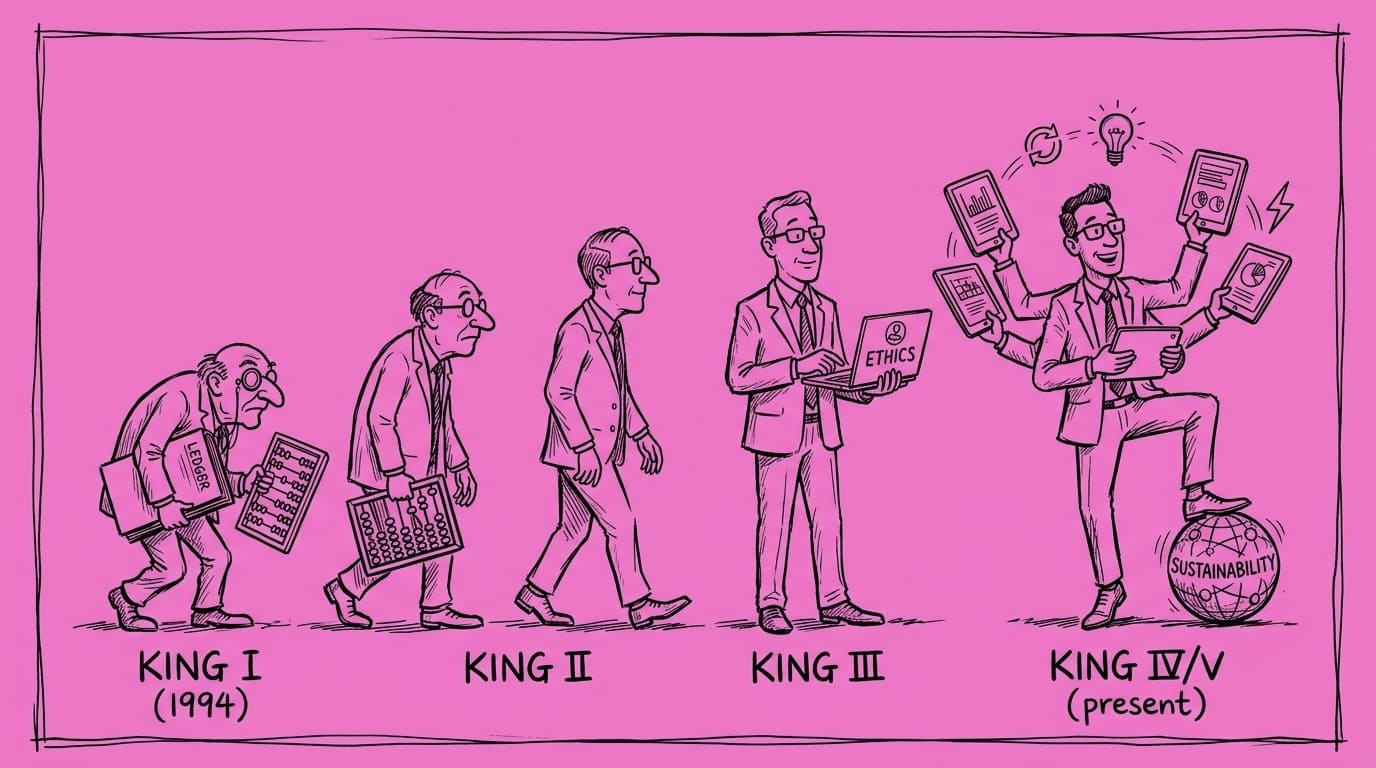
Released in the same year South Africa held its first democratic elections, King I was drafted to help align a newly democratic South Africa with the workings of the modern capitalist market system, and to lay the institutional foundations for structured corporate governance in the country. It was among the earliest governance codes of its kind globally — a genuinely pioneering effort at a pivotal moment in the country’s history.
King II arrived against the backdrop of major international corporate scandals and a rapidly changing global economic and business environment. This report introduced the concept now widely known as “triple bottom line” thinking — the idea that a company’s performance should be judged not only on financial results, but on its social and environmental impact too. It was a genuinely significant broadening of what “good governance” was understood to mean.
King III was made necessary by South Africa’s new Companies Act 71 of 2008, and by continued shifts in international governance trends — including lessons drawn from the 2008 global financial crisis. It introduced the concept of integrated reporting — presenting financial results alongside a company’s social and economic impact in a single, connected report — and applied the “apply or explain” principle, extending its reach to organisations regardless of their manner or place of incorporation, not just JSE-listed companies.
King IV marked the most significant conceptual change of any revision to date. It moved decisively toward integrated thinking (considering the interdependencies between different factors affecting long-term value), stakeholder inclusivity (governing in the interests of employees, customers, communities, and suppliers — not just shareholders), and ethical and effective leadership as its overarching theme. Structurally, it replaced King III’s “apply or explain” regime with “apply and explain” — a subtle but important shift requiring organisations to demonstrate not just whether they applied a principle, but how, and to what effect.
Published on 31 October 2025 and effective for financial years starting on or after 1 January 2026, King V consolidates King IV’s 17 principles into 13, introduces a new standardised Disclosure Framework designed to make governance reporting genuinely comparable across organisations, and — most notably — elevates data, information, and technology governance (including artificial intelligence) into a dedicated strategic principle with direct board-level accountability. Our earlier article on King V covers this most recent evolution in full detail.
What’s Stayed Constant Across Every Version
Despite five very different reports, a few core ideas have carried through unchanged since 1994.
Principles, Not Rigid Rules
Every version of the King Code has taken a principles-based approach rather than a prescriptive, rule-by-rule checklist. This is deliberate — it allows the same framework to apply meaningfully to a JSE-listed banking giant and a small non-profit, without forcing either into a template that doesn’t fit their actual circumstances. Directors are expected to apply the spirit of the principle to their own context, not simply tick a box.
Voluntary in Name, Expected in Practice
None of the five King reports are law. All five have, in practice, become close to unavoidable for any organisation that wants to be taken seriously by investors, regulators, business partners, and the public. This tension — voluntary on paper, expected in reality — has been a consistent feature since King I, and it’s precisely what gives the framework its influence without requiring statutory force.
A Broader View of Who the Business Is Accountable To
Starting from King I’s early nod to South Africa’s new democratic and social context, and building steadily through King II’s triple bottom line, King III’s integrated reporting, and King IV’s explicit stakeholder inclusivity, every revision has pushed further away from a narrow, shareholders-only view of what a company owes the world. King V continues this trajectory, extending accountability into the ethical use of technology and AI.
Why That One-Word Change Actually Matters
The shift from “apply or explain” to “apply and explain” looks like a minor wording tweak, but it represents a genuinely meaningful change in what’s expected of directors. Under an “or explain” regime, an organisation could choose not to apply a principle at all, provided it offered a reasonable explanation why. Under “apply and explain,” the principle must actually be applied — the only thing left to explain is how it was applied and what outcome it achieved. This closed a loophole that had allowed some organisations to treat King III as a menu of optional extras rather than a genuine standard to be met.
Understanding Where You Sit in This History
For many South African directors and business owners, the King Code has always existed somewhere in the background — a document referenced in an annual report, a line item in a compliance checklist, something the company secretary handles. Understanding its actual evolution changes that relationship. Each version of the King Code was a direct response to a real shift in how business, technology, and society were changing — which means the current version, King V, isn’t an arbitrary update. It’s the latest chapter in a framework that has been tracking exactly this kind of change for over thirty years.
Whether your organisation is a JSE-listed company with a dedicated governance department, or a mid-market business trying to understand what “apply and explain” genuinely requires of a five-person board, the starting point is the same: understanding what the framework is actually asking of you, in language that doesn’t require a law degree to follow.
Eli Masechaba brings a Wits Business School foundation in strategic and governance advisory to help directors and boards translate King Code principles — old and new — into practices that genuinely fit their organisation, rather than a diluted copy of a framework built for a very different kind of company.