
Beyond the Price Per Litre
How to build a true “fuel security” strategy for your commercial fleet — because the discount on today’s invoice tells you almost nothing about whether your trucks will be moving next month.
For years, most logistics operators, mining companies, and fleet managers have approached fuel procurement with a single question: who’s offering the best discount per litre today? It’s an understandable instinct — fuel is often the largest controllable cost on the budget. But treating fuel purely as a commodity to be shopped on price, with no regard for how secure and reliable that supply actually is, is a strategy that’s about to be tested in ways most South African businesses have never had to plan for.
South Africa Is Restructuring National Fuel Security
In July 2026, South Africa’s Department of Mineral and Petroleum Resources published its draft Strategic Petroleum Stocks Policy for public comment — a direct response to the global oil supply pressure caused by the Iran-US conflict and the disruption to shipping through the Strait of Hormuz. The draft policy proposes expanding South Africa’s strategic reserves from roughly 13–14 days of national cover to 60 days, targeting a stockpile of approximately 36 million barrels.
Critically for commercial fuel buyers, the policy doesn’t stop at government reserves. It proposes making it mandatory for all licensed private fuel wholesalers, manufacturers, and importers to hold additional reserve stock of their own — split roughly 70% crude oil and 30% refined product, rotated regularly to prevent degradation — at their own commercial expense. The draft policy also outlines rationing provisions and a formal emergency escalation framework, including a “Level 3 fuel shortage emergency” designation, for use if a genuine supply crisis materialises.
This is a live policy conversation, not a settled outcome — the draft remains open for public consultation, and the exact final requirements may shift. But the direction of travel is unmistakable: South Africa is moving from an assumption of abundant, reliable fuel supply toward active national contingency planning for scarcity. Any commercial fleet or logistics operation that hasn’t started thinking about its own fuel security in response is behind where the market is already heading.
Why “Cheapest Per Litre” Is an Incomplete Strategy
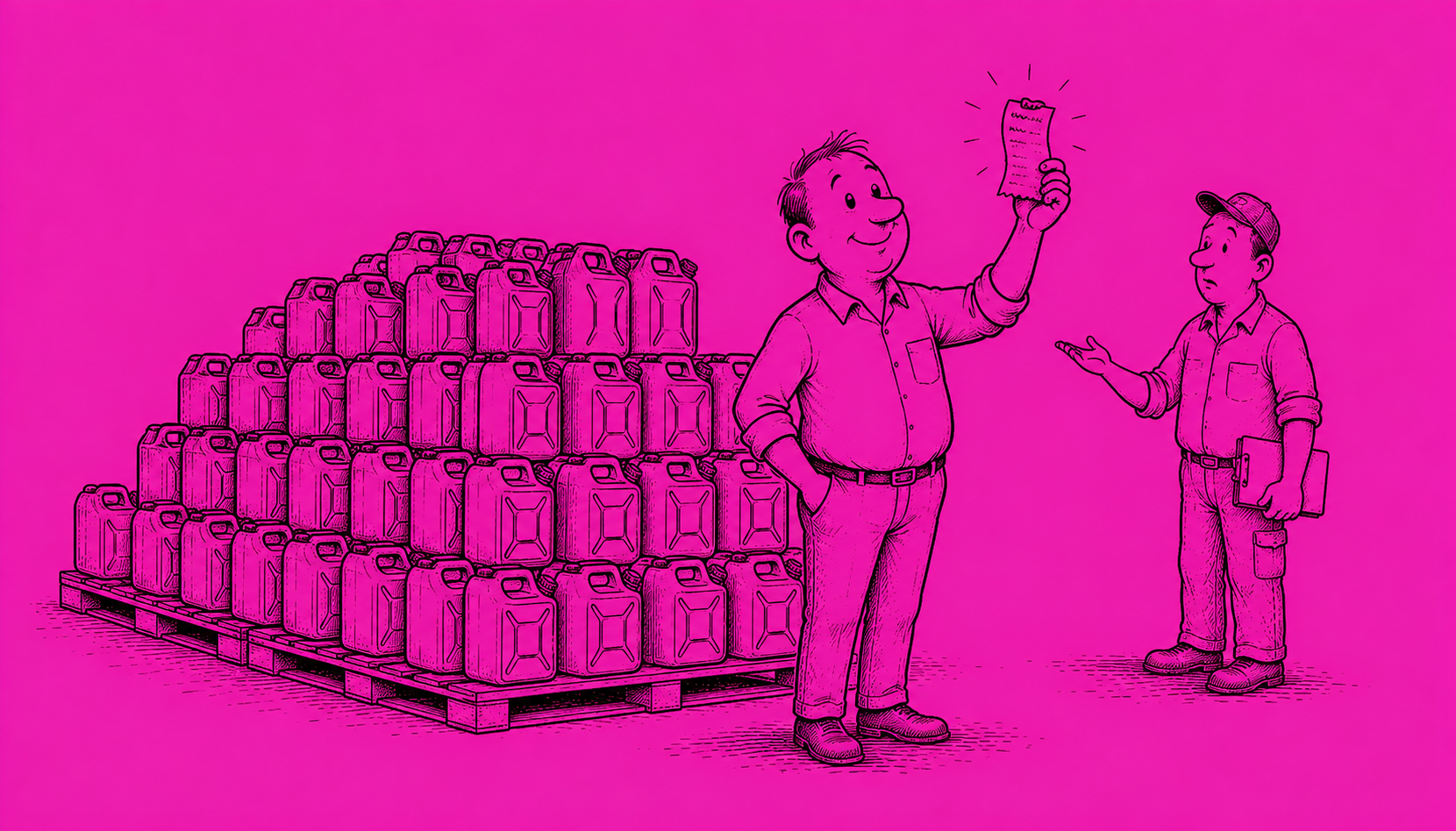
A great price on a delivery you can’t rely on isn’t actually a great price.
Most logistics and mining companies evaluate fuel suppliers on exactly one metric: the discount per litre. It’s an easy number to compare, it shows up clearly on a spreadsheet, and it feels like the responsible, cost-conscious thing to optimise for. The problem is that price per litre only tells you what today’s transaction costs — it tells you nothing about whether that supplier will actually be able to deliver reliably next month, next quarter, or during the exact kind of global supply disruption the government is now actively planning around.
Fuel security is a different, broader question entirely: not “what’s the cheapest price I can find today,” but “how confident am I that my fleet will keep moving, on schedule, regardless of what’s happening in the wider market?” These two questions can point toward completely different suppliers — and the businesses that only ever ask the first one are the ones most exposed when conditions genuinely tighten.
The Hidden Risks Price-Per-Litre Never Shows You
The real variables that determine whether your fleet keeps moving when conditions get difficult.
Local Delivery Lead Times
How long does it genuinely take from placing an order to fuel arriving on your site — not on a good day, but consistently, including during periods when demand across the market spikes? A supplier offering a marginally better price but a considerably longer or less predictable lead time is quietly transferring risk onto your operation, one that only becomes visible when a delivery is late and a delivery run or shift is sitting idle.
Depot and Storage Capacities
As covered in our article on minimum requirements for bulk fuel storage, your own on-site tank capacity — and how it’s structured relative to your actual consumption rate — directly determines your buffer against any disruption upstream. A fleet running on minimal on-site storage, refilled just-in-time, has essentially no margin for error if a supplier’s delivery is delayed by even a few days. Understanding your genuine storage buffer, and whether it’s adequate for the realistic disruption scenarios your operation faces, is a core part of fuel security that a per-litre price comparison never captures.
Payment Terms That Don’t Choke Your Cash Flow
Aggressive upfront payment demands — the kind covered in our article on spotting a fuel scam — aren’t only a fraud red flag. Even with a completely legitimate supplier, payment terms that don’t align with your business’s actual cash flow cycle create their own operational risk, forcing difficult trade-offs between fuel security and working capital elsewhere in the business. A genuinely strategic fuel supply relationship structures payment terms around what your business can sustainably manage, not just what maximises the supplier’s cash position.
Supplier Resilience During Genuine Market Stress
Not every fuel supplier has the same underlying resilience when the broader market tightens. A supplier with direct terminal access and documented, licensed wholesale credentials — as covered in our fuel scam awareness article — is structurally better positioned to maintain supply during a squeeze than one operating through a thinner, less verified chain of intermediaries. This is precisely the kind of distinction that a spreadsheet comparing only price per litre will never surface, and precisely the kind of distinction that matters most during exactly the sort of disruption South Africa’s draft policy is now preparing the whole country for.
Why This Matters More for Your Business Than for the Average Motorist
A private motorist who finds their local forecourt out of stock can usually drive to the next one. A logistics company with twenty trucks on the road, or a mine running continuous shift operations, does not have that flexibility. The scale of your fuel dependency is exactly what makes fuel security a genuinely strategic concern rather than a minor operational inconvenience. The businesses that will weather a supply disruption best are the ones that treated fuel security as a deliberate strategy well before the disruption arrived — not the ones scrambling to find an alternative supplier in the middle of a crisis, at exactly the moment when every other business in the market is scrambling for the same limited supply.
Fuel Security Is a Strategy, Not a Single Transaction
Eli works with clients as a strategic advisor, not just a fuel broker — helping commercial fleets and industrial operations build a secure, structured supply relationship that helps guarantee delivery even when the rest of the market is scrambling.
Understanding your fleet’s genuine consumption patterns, your current on-site storage buffer, and your realistic exposure to a supply disruption — rather than assuming your current arrangement is adequate simply because it’s worked so far.
Structured sourcing through licensed, verified channels — the same terminal-direct principle covered in our articles on avoiding fuel scams and the true cost of cheap diesel — so your supply isn’t dependent on a chain of intermediaries who may simply be unreachable during a genuine market squeeze.
A supply structure genuinely designed around your operation’s cash flow and delivery reliability needs — not a generic arrangement that happens to offer the lowest headline price while quietly leaving you exposed on the variables that actually determine whether your fleet keeps moving.
The government’s own draft policy makes the underlying point clearly: South Africa is preparing for a world where fuel supply cannot simply be assumed. Businesses that build their own fuel security strategy now — rather than waiting for a crisis to force the question — will be the ones still moving when the rest of the market is asking why their cheapest supplier has suddenly gone quiet.