
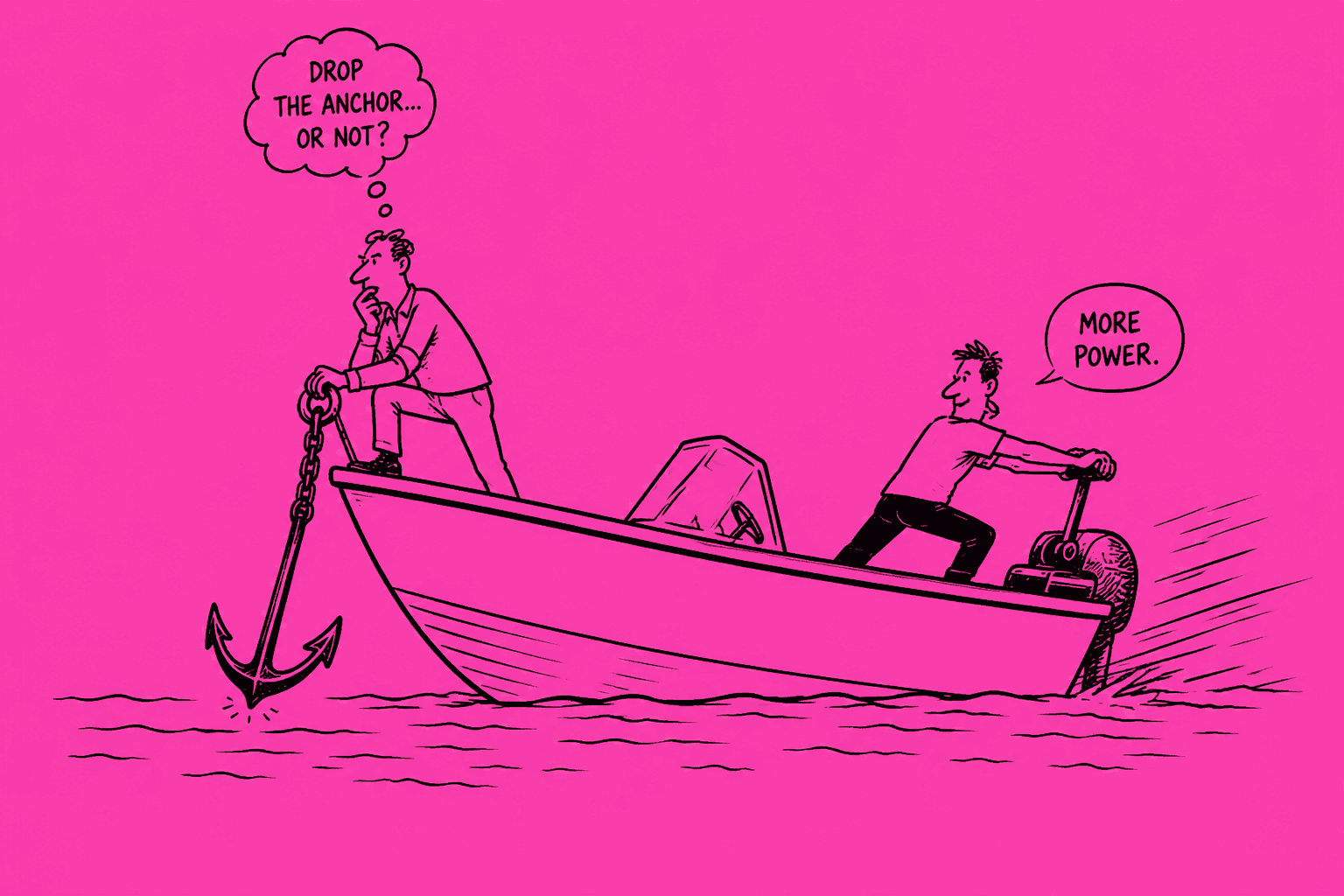
When to Pivot vs When to Persevere
An executive guide to the hardest decision in business — and the science, the psychology, and the hard-won experience that separates leaders who get it right from those who find out too late.
Every business hits a wall at some point. The market softens, revenue dips, the team gets nervous, and every Monday morning brings a new variation of the same question: is this a storm we need to weather, or a sign we need to fundamentally change what we’re doing? This is the question that separates the leaders who build lasting businesses from the ones who either give up too soon or hold on too long. After thirty years in corporate environments, Eli Masechaba has seen both. This article is the honest guide to telling the difference.
Spotting the Difference Early
Not all falling revenues are the same problem. Misdiagnosing this one is where the expensive mistakes begin.
Is the economy just having a bad year and everyone is feeling it — or is your specific product becoming irrelevant while the world moves on without you?
There is a critical distinction between a cyclical problem and a structural problem — and the response to each is almost exactly opposite. Getting this diagnosis wrong is one of the most common and most costly mistakes South African business leaders make.
A cyclical problem is temporary. It is caused by external conditions — a recession, a currency shock, an interest rate cycle, a sector slow-down — that will eventually reverse. Your product is still valuable, your customers still need you, and the fundamentals of your business model are sound. The correct response is to manage cash flow, hold the line, protect key relationships, and wait it out with discipline. This is when perseverance is not stubbornness. It is strategy.
A structural problem is permanent. It is caused by something that is not going to reverse — a fundamental shift in how customers buy, a technology that has made your offering obsolete, a competitor who has found a way to deliver your value proposition at a fraction of your cost, or a market that has simply moved on. The correct response is not to work harder. It is to change direction before the runway runs out. This is when pivoting is not giving up. It is survival.
“Every industry will be disrupted. The question is not whether the disruption will come, but whether you will be the disruptor or the disrupted — and how early you can tell the difference.”
Clayton Christensen — The Innovator’s Dilemma, Harvard Business School (1997)Christensen’s disruption research, conducted at Harvard over decades, showed that companies in structural decline almost universally misidentified their problem as cyclical — right up until it was too late. They kept investing in the existing business model, improving what they already did, optimising and refining — while the disruption was happening at the low end of the market, where they weren’t looking. By the time the disruption was visible, the window for a meaningful response had often already closed.
In the South African context, this pattern has played out visibly across multiple sectors — retail, media, financial services, logistics. Load shedding, for example, created a structural shift in the energy supply market that opened entirely new business models for companies that read it early. For businesses that assumed it was temporary and didn’t adapt their operations, the energy cost structure became a permanent competitive disadvantage.
Leading indicators — metrics that predict future performance — are the early warning system most businesses are not watching carefully enough. By the time lagging indicators like annual revenue and profit move, the structural problem has usually been developing for 18 to 36 months. The metrics that catch it earlier are: customer acquisition cost trend (rising CAC with falling lifetime value = value proposition erosion), gross margin trend over 36 months (structural compression means structural problem), customer retention rate quarter by quarter, and your net revenue vs the overall market size. A business losing 3% market share per year in a growing market is a business in structural decline regardless of what the top-line revenue growth number says.
Pride Pricing — The Sunk Cost Fallacy
This is the psychological trap that turns a recoverable situation into a catastrophic one. And almost every leader falls into it.
You’ve spent R30 million building something that isn’t working. And now you’re about to spend another R20 million trying to fix it — not because the numbers support it, but because you can’t stand the thought of admitting the first R30 million is gone.
In 2003, British and French officials were asked in a research study why the Concorde programme had continued long after it was clear it would never be commercially viable. Both governments had committed so much money, so much political capital, and so much national pride to the project that stopping felt impossible — even when the economics were unambiguous. Every additional pound and franc spent was justified by what had already been spent. This is why the sunk cost fallacy is sometimes called the Concorde Fallacy. The plane flew at a loss for 27 years before it was finally retired.
The same logic plays out in South African businesses every week — just without the supersonic aircraft. A product line that has never been profitable gets another two-year development budget because the team has been working on it for four years. A market entry that is clearly failing gets more marketing spend because leadership already announced it publicly. A division that should be sold or shut down keeps getting resources because it was the founder’s original business. The reasons are always different. The psychological mechanism is identical.
“Losses loom larger than gains. People are more motivated to avoid a loss than to achieve an equivalent gain — and this asymmetry is one of the most powerful forces in human decision-making.”
Daniel Kahneman & Amos Tversky — Prospect Theory, Econometrica (1979) — Nobel Prize in EconomicsKahneman and Tversky’s landmark research demonstrated that human beings are psychologically wired to treat losses as approximately twice as painful as equivalent gains are pleasurable. This is not a personality trait — it is a cognitive architecture that applies to almost everyone. The decision to stop investing in a failing project feels, emotionally, like a loss — because it makes the previous investment feel wasted. In reality, that investment is already spent regardless of what happens next. The question is only whether good money follows bad. But the brain doesn’t experience it that way, and leaders who are unaware of this dynamic will consistently make decisions that protect their ego over their balance sheet.
How to Know If You’re In the Trap
Ask yourself one question, and answer it honestly: “If we were making this decision fresh today, with no prior investment and no prior commitment, would we choose to fund this?” If the answer is no — if the only reason to continue is what has already been spent — you are in the sunk cost trap. The R30 million is gone whether you spend the next R20 million or not. The only financial decision left is whether the next R20 million has a positive expected return on its own merits.
Removing the sunk cost from the analysis does not disrespect the effort that went into the previous investment. It is the only way to make a rational decision about what happens next. Emotion is not a financial instrument. It has no place in this calculation.
The South African Version: “We’ve Come Too Far to Stop Now”
In thirty years of corporate experience across South African business environments, this phrase — or some version of it — appears reliably in the boardrooms of businesses that are about to make a very expensive mistake. The logic seems sound: significant investment has been made, people have committed significant time and energy, and stopping now would make all of that feel pointless. The problem is that “coming far” is not a financial indicator. It is a narrative. The business is not obligated to continue down a path simply because it has already walked a long way down it. Sometimes the most strategically courageous thing a leadership team can do is acknowledge that the direction was wrong and change it — before the runway disappears entirely.
The Anatomy of a Real Turnaround
If the diagnosis is “this business needs to be saved,” the work is specific, sequenced, and nothing like what most leaders instinctively do first.
Firing people to cut costs is usually the last resort, not the first move. A real turnaround fixes why the business is bleeding — which almost always has nothing to do with headcount.
Most business leaders, when confronted with a turnaround situation, do the same thing first: they look at the cost line and reach for the headcount. Retrenchments are visible, immediate, and produce a number that looks decisive on a spreadsheet. They are also, in most turnaround situations, the wrong first move — and in some situations, a devastating one.
Stuart Slatter and David Lovett’s foundational research on corporate turnarounds — one of the most comprehensive empirical studies of business recovery ever conducted — identified that successful turnarounds almost always follow a specific sequence. The businesses that survived and recovered did not start with costs. They started with cash, then addressed strategy, then addressed costs, then rebuilt.
Stabilise Cash First — Not Profit
A business in distress does not die from low profit. It dies from running out of cash. These are not the same thing, and in a turnaround, the distinction is everything. The first 90 days of a real turnaround are about cash: stopping discretionary spending, accelerating collections, negotiating payment terms with suppliers, drawing down any available credit facilities, and identifying within the next 30, 60, and 90 days exactly how much cash the business will have and will need. Only when you have visibility of the cash position can you make every other decision with clarity. Without it, you are operating blind in a moving vehicle.
Identify the 20% That Generates 80% of the Value
The Pareto principle — observed across hundreds of business contexts — reliably applies in distressed businesses: a small fraction of the product portfolio, client base, or service offering generates the overwhelming majority of the margin. In a healthy business, leaders can afford to carry the underperforming 80% because the performing 20% subsidises it. In a business fighting for survival, that subsidy is no longer available. The turnaround requires identifying the value-generating core with clarity and focusing every available resource on it — while stopping or suspending everything else. This is painful. It is also the only move that works.
Renegotiate Contracts Before Cutting People
Supplier contracts, lease agreements, and service level agreements negotiated in better times frequently contain terms that are no longer commercially appropriate for the business’s current position. In a turnaround, these must be systematically reviewed and renegotiated. South African businesses frequently discover that suppliers — who would rather have a renegotiated contract than a client that goes into Business Rescue — are more willing to restructure terms than anticipated. Renegotiating a single major supplier contract can release more cash than a significant retrenchment event, without destroying capability or triggering the full legal and human cost of workforce reduction.
Rebuild Trust — Starting With the People Who Are Staying
A business in turnaround has almost certainly lost the trust of some stakeholders — possibly clients, possibly suppliers, possibly the bank, possibly employees. The sequence of trust rebuilding matters. Internal trust — with the team that remains — comes first, because without it, the external trust rebuilding is performative. People who have watched a business struggle need transparency about what is happening, what the plan is, and what is expected of them. Research consistently shows that clear, honest communication during organisational crisis produces better performance and lower voluntary turnover than managed optimism or opacity. People can handle difficult truths. What they cannot handle, and what drives the best people out first, is uncertainty and silence.
Know When Business Rescue Is the Right Tool
South Africa’s Companies Act (Chapter 6, Sections 128–153) provides for Business Rescue proceedings — a formal, court-supervised process that gives a financially distressed company temporary protection from creditors while a Business Rescue Practitioner develops and implements a plan to rescue the company or to achieve a better outcome than immediate liquidation would produce. Business Rescue is not failure. It is a legislated turnaround mechanism, and for businesses that qualify — those that are financially distressed but have a reasonable prospect of rescue — entering Business Rescue early produces dramatically better outcomes than delaying until the options have run out. The most common mistake South African businesses make with Business Rescue is waiting six months too long to apply for it.
When the Answer Really Is: Change Direction
A pivot is not giving up. It is applying everything you have learned to a better version of what you are trying to build.
The best business pivots in history weren’t moments of defeat. They were moments of clarity — when a leader finally saw what the business could actually be, instead of what they had originally planned it to be.
Eric Ries, whose work on lean startup methodology formalised the language of pivoting in the business world, described a pivot as a structured course correction designed to test a new fundamental hypothesis about the product, strategy, and engine of growth. This is an important definition, because it distinguishes a pivot from two things it is often confused with: a random lurch when the current strategy fails, and a minor tactical adjustment that doesn’t change anything fundamental.
A real pivot changes something at the core — the customer segment, the business model, the value proposition, the revenue mechanism, or the channel to market. It is a strategic decision, not a desperate one, and it is most powerful when made with enough runway remaining to execute it properly. The businesses that pivot successfully are not the ones that abandoned their strategy at the first sign of difficulty. They are the ones that gathered enough evidence that the current direction was structurally wrong — and then changed it deliberately, with clarity about what they were pivoting toward, not just away from.
Before committing to a pivot, apply this diagnostic: is the business struggling because the strategy is wrong — the market doesn’t want what you’re offering, or you’re offering it to the wrong people, or your business model doesn’t generate sustainable economics — or because the execution is poor — the right strategy is in place but is being implemented badly?
These require opposite responses. A strategy problem requires a pivot. An execution problem requires fixing what you’re already doing. The most common strategic mistake in South African leadership is pivoting to escape an execution problem — changing direction instead of addressing the operational discipline, quality, team, or process issues that are actually causing the underperformance. The new direction then fails for the same underlying reasons the old one did.
What the Best South African Business Leaders Do Differently
Thirty years of observing South African businesses in growth, stability, crisis, and recovery produces a pattern. The leaders whose businesses survive difficult periods and emerge genuinely stronger tend to share a specific quality: they are honest with themselves earlier than their peers. They see the structural shift when it is still small. They acknowledge the sunk cost trap before the next large investment is committed. They begin the turnaround conversation in the boardroom before it is forced on them by the bank or the creditors.
This is not instinct. It is a discipline — and it is a discipline that is significantly easier to maintain when someone outside the business is asking the right questions without a stake in the answers. The most valuable thing an external advisor brings to a business in difficulty is not a solution. It is the willingness to name what everyone in the room already suspects but nobody wants to say out loud.
Thirty Years of Knowing Which Call to Make
The concepts in this article are not theoretical. They are drawn from decades of business reality — the accumulated pattern recognition that comes from watching businesses navigate recessions, disruptions, leadership crises, market shifts, and all the particular challenges that South African commercial environments serve up in combination. Eli Masechaba brings that pattern recognition to every client engagement, alongside a Wits Business School foundation in commercial strategy and organisational management.
What this means in practice is that when your business hits a wall, you are not getting a generic framework applied to your situation. You are getting someone who has seen your situation — or something very close to it — and who knows what the data usually means, what the temptation to misread it looks like, and what the decision that actually matters is.
Diagnosing whether the problem is cyclical or structural. Identifying where sunk cost thinking has entered the leadership conversation. Building the turnaround sequence that stabilises cash, identifies the core value engine, and rebuilds stakeholder trust in the right order. Knowing when the right answer is a deliberate pivot — and what that pivot should be toward, not just away from. This is the consulting work. It is specific, it is honest, and it is grounded in thirty years of seeing what works in the real South African business environment.