
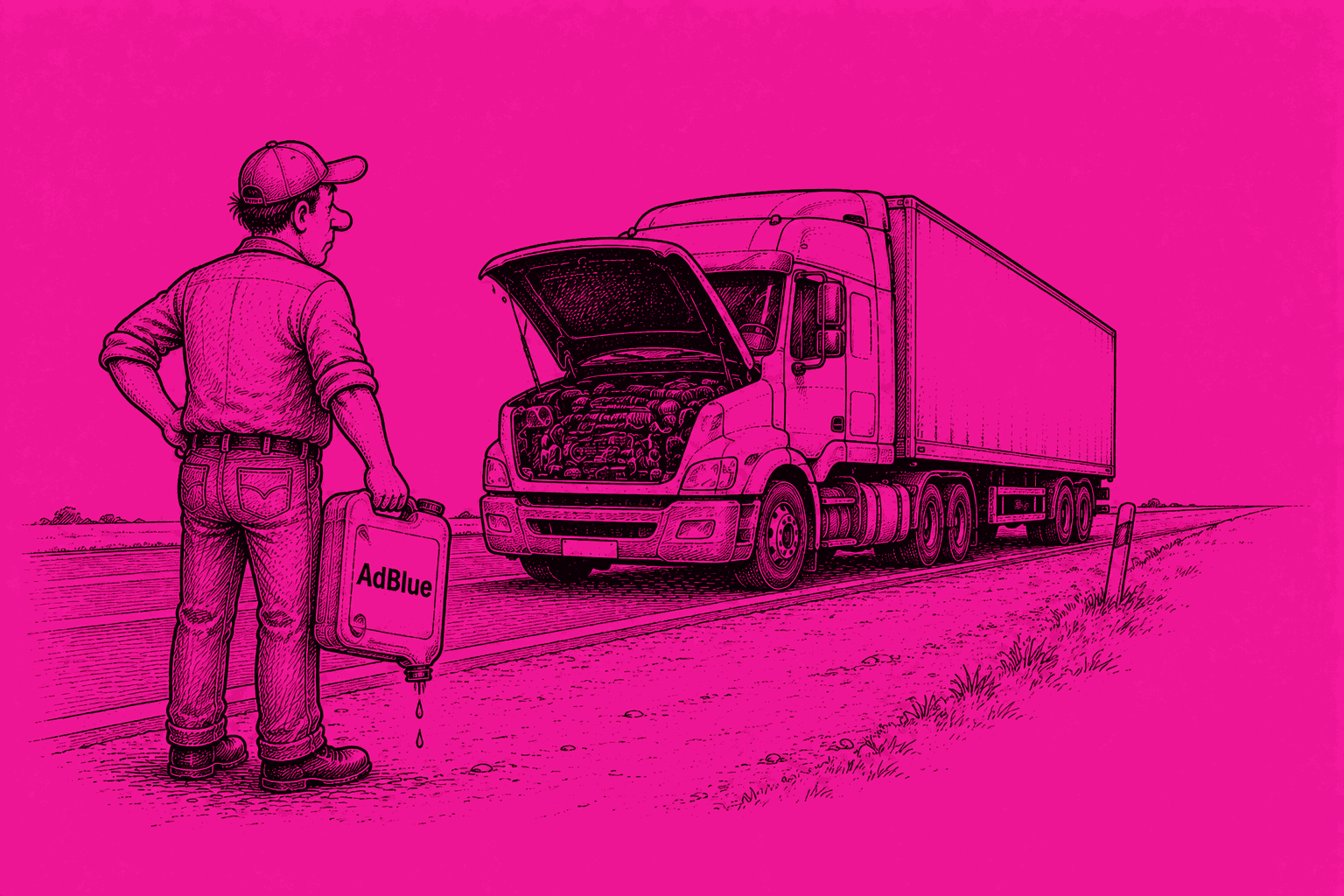
AdBlue Isn’t a Top-Up. It’s the Fluid That Decides If Your Truck Moves.
Most fleet owners think of AdBlue as an afterthought next to diesel. It isn’t. Run dry, run fake, or run wrong, and the consequence isn’t a warning light — it’s a derated truck on the side of the N3 with a full load and a deadline.
I still get the same call, roughly every few months, from a fleet owner who’s had a truck sitting in a lay-by for six hours because the AdBlue light came on and nobody took it seriously. It’s rarely about the truck itself — it’s about a fluid most operators still treat as an inconvenience rather than the thing standing between their fleet and a roadside derate. If you’ve read my earlier pieces on fuel card fraud and cross-border corridor risk, this is the companion problem hiding in plain sight: a second fluid, a second point of failure, and a second place where cost gets quietly bled out of a fleet.
What AdBlue Actually Does
It’s not a fuel additive. It’s a separate emissions system with its own rules.
AdBlue doesn’t make your engine run — it cleans up what comes out the back of it, and if it runs out, the truck is designed to stop you from driving until you fix it.
Every modern diesel truck built to Euro 5 or Euro 6 emissions standards carries Selective Catalytic Reduction, or SCR — a second exhaust treatment system sitting between the engine and the tailpipe. Diesel exhaust fluid, sold under the trademarked name AdBlue, is stored in its own separate tank and injected into the hot exhaust stream ahead of the SCR catalyst. Under heat, the fluid breaks down into ammonia, and that ammonia reacts inside the catalyst with nitrogen oxide gases from combustion, converting them into harmless nitrogen and water vapour released as steam.
AdBlue itself is a precisely engineered chemical product, not a generic top-up. Under the international ISO 22241 standard, it must be an aqueous solution of high-purity urea at 32.5% concentration — with tolerance limits typically held between roughly 31.8% and 33.2% — mixed with 67.5% deionised water, with strict caps on impurities like biuret, aldehydes, and trace metals that can poison the catalyst or damage injectors. It’s non-flammable, non-toxic, and colourless despite the name — but it is not forgiving of contamination, and it is not a fluid where “close enough” is good enough.
The critical design point every fleet operator needs to internalise: SCR systems are built to fail safe from an emissions standpoint, which means they fail hard from an uptime standpoint. The system is designed so the vehicle cannot simply “ignore” a dosing problem — it responds by restricting power.
Sensor or dosing fault detected
The ECU continuously reads NOx sensor data, tank levels, fluid quality, and dosing pressure. A NOx sensor fault, a clogged injector, or fluid that doesn’t match the expected chemical signature triggers a warning code — the same way a bad batch of fuel might trip a fault light, but tied specifically to the emissions system.
Warning stage — dashboard alert, full power
Most systems give an early window: dashboard warnings, sometimes an audible alert, sometimes a countdown in kilometres. The truck still drives normally. This is the stage fleets most often ignore, because nothing has visibly changed yet.
Derate — power and speed restricted
If the fault isn’t resolved, the ECU begins restricting torque or capping road speed — sometimes to as low as 20 km/h on Euro 6 trucks. A fully loaded truck at highway speed suddenly limited to walking pace is not a minor inconvenience; it’s a safety hazard on its own.
Limp mode or no-restart lockout
In the most severe cases — AdBlue tank fully empty, or the system detecting fluid it judges non-compliant — many trucks are engineered to refuse to restart once switched off, or to drop into a minimal-power limp mode that effectively strands the vehicle until the fault is cleared.
Why This Isn’t “Just Another Warning Light”
A derate doesn’t wait for a convenient moment. It triggers mid-route, often on a loaded truck, often far from a workshop. The cost isn’t only the repair — it’s the missed delivery window, the driver stranded roadside, and on cross-border corridors, potentially a compliance stop that turns a fluid problem into a fine and a prohibition on movement until it’s fixed.
Fake AdBlue: The Fraud Hiding Inside a Legitimate Product
Same blue container. Different chemistry. Same consequences as running dry.
Because AdBlue looks like water and nobody checks it, it’s an easy thing to dilute, mislabel, or sell uncertified — and your SCR system will not forgive the difference.
South Africa’s fuel sector has a well-documented adulteration problem — illuminating paraffin blended into diesel, false import declarations, and a running enforcement effort from SARS and industry bodies like SAPIA against fuel fraud broadly. AdBlue sits in the same risk category for a simple reason: it’s a commodity liquid, sold in unmarked-looking containers, that almost nobody at fleet level has the equipment to test. A cowboy blender selling under-concentration urea solution, water with the wrong additive package, or product with no VDA or ISO 22241 certification behind it can look identical to the genuine article until it’s already done damage.
The failure mode with counterfeit or non-compliant AdBlue is different from simply running dry — and in some ways worse, because it’s slower and harder to trace back to its source. Low-quality or contaminated fluid accelerates crystallisation inside injectors and dosing lines, degrades NOx sensors, and can poison the SCR catalyst itself. None of this shows up as an instant fault. It shows up weeks later as an unexplained pattern of derates, rising AdBlue consumption for no clear reason, or a catalyst replacement bill that a workshop traces back to fluid quality rather than a mechanical fault.
Flag for the record: exact volumes or prevalence figures for counterfeit AdBlue specifically within the South African market are not something I can verify to a standard I’d put a number on — the documented fraud enforcement locally centres on diesel and paraffin adulteration rather than published AdBlue-specific case data. The mechanism and risk described here is well established internationally and mechanically consistent with SA’s broader fuel fraud environment; treat the absence of a local statistic as a gap, not a reason to relax vigilance.
The rule I give every fleet manager I consult with: if your supplier can’t produce a Certificate of Analysis on request, you’re not buying AdBlue — you’re buying an unknown liquid that happens to be blue.
Eli MasechabaDosing Errors — The Quiet Cost Nobody Budgets For
Too little AdBlue triggers faults. Too much wastes money and can still trigger faults.
The system doses itself automatically — but sensors drift, injectors clog, and when the dosing is wrong in either direction, it costs you either in fluid or in downtime.
Dosing is meant to be entirely automatic — the ECU calculates the correct injection rate based on engine load, and the driver’s only job is keeping the tank topped up. In practice, dosing accuracy degrades for mechanical reasons long before anyone notices: crystallised deposits restrict injector flow, a weakening dosing pump can’t sustain correct pressure, and a drifting NOx sensor feeds the ECU bad data that skews the whole calculation.
Genuine AdBlue consumption typically tracks at roughly 4–6% of diesel volume burned — a useful sense-check for any fleet manager watching fuel and fluid costs side by side. A sharp, sustained move away from that ratio in either direction is itself a diagnostic signal: unusually high consumption often points to a dosing or sensor fault forcing over-injection to compensate for inaccurate readings; unusually low consumption suggests under-dosing that’s quietly building toward a fault code and, eventually, a derate. Neither is something to wait out. Both are cheaper to diagnose at a workshop on a Tuesday morning than to discover on a loaded truck at a weighbridge.
What This Costs In Practice
NOx sensor replacement typically runs into several hundred dollars-equivalent per unit, and many trucks carry two. That’s before towing, missed delivery penalties, or a driver sitting idle roadside on a loaded run. None of these costs show up as a single line item — they scatter across maintenance, fuel, and logistics budgets, which is exactly why they’re so easy for a fleet to underestimate until the pattern is pointed out.
The Bottom Line
AdBlue gets treated as a footnote next to diesel because it’s cheap, it’s automatic, and most of the time it just works. That’s precisely what makes it dangerous to ignore — the failures are rare enough that fleets don’t build habits around it, and severe enough that when they hit, they hit at the worst possible moment: loaded, on the road, against a deadline.
The fix isn’t complicated. Buy certified product from a traceable supplier, keep a Certificate of Analysis on file, watch the consumption ratio against diesel burned, and treat the first dashboard warning as the deadline — not the derate three hundred kilometres later.
This sits alongside the fuel card fraud and telematics risks I’ve written about before: it’s another point in a fleet’s operation where the failure is invisible until it isn’t, and where a small amount of discipline upfront saves a very expensive surprise later.