
From Well to Wheel: How Fuel Actually Gets to Vanderbijlpark
The oil and gas industry describes its own value chain in three stages — upstream, midstream, and downstream. Understanding what happens at each stage explains almost everything about how South Africa’s fuel actually reaches your tank, and why the price you pay behaves the way it does.
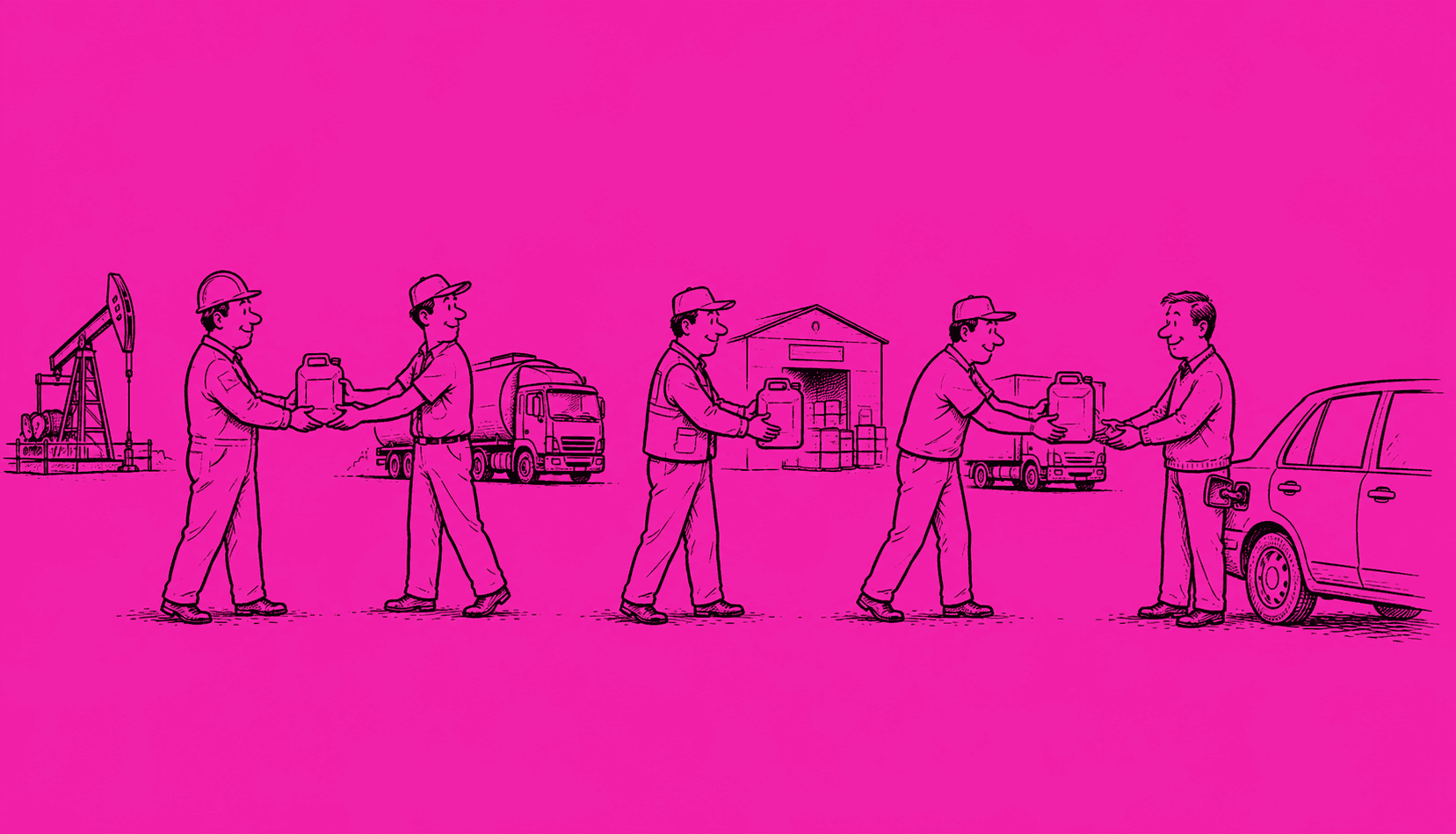
Every litre of fuel that goes into a vehicle in South Africa has already travelled a genuinely global journey — often starting on a different continent entirely — before it ever reaches a local forecourt. The global industry breaks this journey into three broad stages: upstream (finding and extracting oil and gas), midstream (processing and moving it), and downstream (refining it into usable products and getting it to the customer). South Africa’s version of this journey has its own distinct character, shaped by geography, geology, and one uniquely South African industrial innovation. Here’s how it actually works, end to end.
Exploration and Import — The Beginning
South Africa’s fuel story starts with a simple geological reality: there isn’t much crude oil under South African soil.
Unlike oil-producing nations with substantial underground reserves, South Africa lacks large domestic crude oil deposits. The overwhelming majority of the country’s crude oil — commonly cited at around 95% — is imported from other countries, with Saudi Arabia and Nigeria historically representing major sources within that import mix. This crude arrives by ocean tanker into South Africa’s two primary receiving ports: Durban and Cape Town.
This import dependency is the foundational fact that shapes almost everything downstream of it — literally and figuratively. It’s why South Africa’s fuel pricing is built on an import parity basis (covered in detail in our fuel pricing articles), and it’s why currency movements and international shipping conditions have such an outsized effect on what South Africans pay at the pump, regardless of what’s happening domestically.
Refining — Making the Fuel
Once crude oil arrives, it isn’t fuel yet. It’s raw material waiting to be sorted.
Crude oil arriving at Durban or Cape Town heads to an oil refinery, where it’s heated inside large distillation towers. Different components of the crude oil turn to vapour at different temperatures, and this difference is exactly what allows the refinery to separate the original mixture into distinct, usable products — petrol, diesel, jet fuel, and paraffin among them.
The Simplest Way to Picture It
Think of how steam rising from a pot of hot water turns back into droplets the moment it touches a cold glass surface. Distillation towers work on exactly this principle, just at industrial scale: different parts of the crude oil vaporise at different heat levels as they rise through the tower, then condense back into liquid at the specific height where the temperature matches their individual boiling point. That’s the entire secret behind how one messy mixture becomes several clean, distinct fuels. Our dedicated article on distillation towers goes into this process in much greater technical depth.
Conventional Crude Refining
Imported crude oil is processed at South Africa’s remaining operational refineries, separating it into the standard slate of refined products through the distillation and conversion processes described above.
Synthetic Fuel From Coal — South Africa’s Unique Advantage
This is where South Africa genuinely stands apart from almost every other country in the world. Sasol, through decades of proprietary chemical engineering, converts coal into liquid petrol and diesel using a process rooted in Fischer-Tropsch synthesis. This coal-to-liquids capability means a meaningful portion of South Africa’s fuel supply never touches a crude oil tanker or an international shipping lane at all — it starts as domestic coal and ends as finished fuel, entirely within the country’s own industrial base. This is a genuine strategic asset that very few nations possess at this scale, and it’s part of why South Africa’s fuel security picture is more nuanced than a simple “95% imported” headline suggests.
Distribution — Moving the Fuel
Refined fuel still has to travel hundreds of kilometres before it reaches a town like Vanderbijlpark.
Once fuel has been refined, it needs to move from the coast to the inland economic heartland — Gauteng, the Vaal Triangle, and beyond. This happens through two complementary transport systems, each suited to a different part of the journey.
Pipelines — The Bulk Movement Backbone
Fuel is pumped through long underground pipelines, the majority of which are operated by Transnet. The single most important artery in this network runs from the coast all the way inland to Gauteng, moving enormous daily volumes that road transport alone could never realistically replace. This pipeline is the reason inland South Africa has reliable fuel access at all, despite having no refining capacity of its own in the immediate region.
Trucks and Trains — The Last Mile
From the inland terminal complexes the pipeline feeds into, tanker trucks and rail transport carry fuel the rest of the way — out to regional distribution points and, ultimately, to the local forecourt in towns like Vanderbijlpark, Vereeniging, and Sasolburg. This is the stage most people never think about, but it’s where the fuel supply chain becomes genuinely local, and where the delivery logistics covered in our article on bulk fuel pricing requests actually come into play.
Retail — Buying the Fuel
The final stage is the only one most people ever actually see — but it’s shaped by everything that came before it.
The last step in the journey is the moment you pull up to the pump. The forecourt brands South Africans recognise — Engen, FuelZone, TotalEnergies, and several others — represent the retail face of this entire supply chain. And that retail landscape is currently shifting in a genuinely significant way.
Adnoc Distribution’s Acquisition of Shell’s South African Business
In July 2026, Abu Dhabi National Oil Company’s retail arm, ADNOC Distribution, signed a definitive agreement to acquire 100% of Shell Downstream South Africa from Shell South Africa Holdings, in a deal with an implied enterprise value of approximately $1 billion. The acquisition includes Shell’s network of roughly 580 South African fuel stations, along with its wholesale fuel, aviation, and lubricants operations.
The deal is expected to close in 2027, subject to regulatory approval. In line with South Africa’s Broad-Based Black Economic Empowerment requirements, a 28% stake in the South African business is expected to be sold to a local empowerment partner and an employee stock ownership plan after closing, with ADNOC Distribution retaining a majority stake. Shell’s brand will continue on South African forecourts under a long-term licensing agreement, even as ADNOC Distribution becomes the owner behind the scenes.
This follows a broader pattern of consolidation in South Africa’s fuel retail sector — Vitol’s Vivo Energy became the market leader after acquiring a majority stake in Engen from Petronas in 2024, while Glencore has operated the country’s second-largest network since backing the acquisition of Chevron’s Caltex stations in 2018. South Africa’s fuel retail market, once dominated by long-standing traditional oil majors, is increasingly being shaped by global commodity traders and international energy players entering through acquisition.
What’s particularly notable is why international players find South Africa’s fuel retail sector attractive in the first place: the country’s regulated pricing framework, which insulates retail margins from inflation, currency volatility, and swings in the global oil price, is seen internationally as offering a rare combination of earnings visibility and stable growth potential — a genuinely distinctive feature of the South African fuel market compared to many deregulated markets elsewhere in the world.
The South African government directly regulates the retail price of petrol. This means a litre of petrol costs the same nationally-set price whether you’re filling up in Vanderbijlpark or Cape Town, adjusted only by the zone-based transport cost differentials covered in our pricing articles.
Diesel’s retail price is not regulated in the same way. While a wholesale guideline price is published monthly, individual retailers have more flexibility to set their own diesel margins — which is part of why diesel prices can show more visible variation between different forecourts and regions than the more uniformly regulated petrol price.
One Global Framework, One Distinctly South African Story
Upstream, midstream, downstream — the same three-stage structure that describes the global oil and gas industry describes South Africa’s fuel supply chain too. But the specific South African version of that story has its own character: heavy reliance on imported crude through Durban and Cape Town, a genuinely unique domestic synthetic fuel capability through Sasol that few other nations can match, a pipeline network that makes inland fuel access possible at all, and a retail sector currently being reshaped by major international players who see real value in South Africa’s regulated pricing environment.
Every one of these stages ultimately determines what happens the next time you pull into a forecourt — the price on the sign, the reliability of supply, and increasingly, which global company’s balance sheet sits behind the brand on the pump.